2 desert style lawn replacements and a confession about travelling online

I’ll start with the confession: I sometimes take “drives” around cities and towns on Google, using Google’s street view.  It gives me a chance to look at how people garden in places I may not have visited.  I also look for examples of lawn replacements where green grass in front yards has obviously been removed and drought tolerant plants installed instead.

Most recently I “drove” around Tucson, Arizona and El Paso, Texas and, instead of lawn replacements or dry, sun-baked lawns, I saw a lot of non-gardens in front of homes. What I consider non-gardens are front yards with a random bush or two here or there, nothing seemingly planned or cared for.  These spaces may have rock mulch, but as often as not, they don’t. And they are not native plant gardens either. Lawn replacement wasn’t even an issue in those places.

Both cities have low annual rainfall –10 inches for El Paso, 12 inches for Tucson–which puts them both clearly into a desert climate category with most of the rain coming during the summer monsoon.

With a little planning, however, non-gardens can be transformed into attractive spaces that will please the eye and increase property values.

Full disclosure: These examples below are lawn replacements.  Instead of  starting with non-gardens these homeowners removed thirsty front lawns temporarily creating “non-gardens”.

Here are two examples I particularly like. Neither require much maintenance at all after they are established. (And for 4 more landscaping ideas for hot gardens, go here.)

Lawn Replacement garden #1

decomposed granite front lawn replacement hot gardens

These homeowners stripped out the grass and planted a border of non-thirsty desert plants in a curving shape around a plot that looks like bare earth but is in fact decomposed granite. The decomposed granite protects the underlying soil from erosion during heavy rains and is excellent for weed control.

Lantana ground cover mixed colors
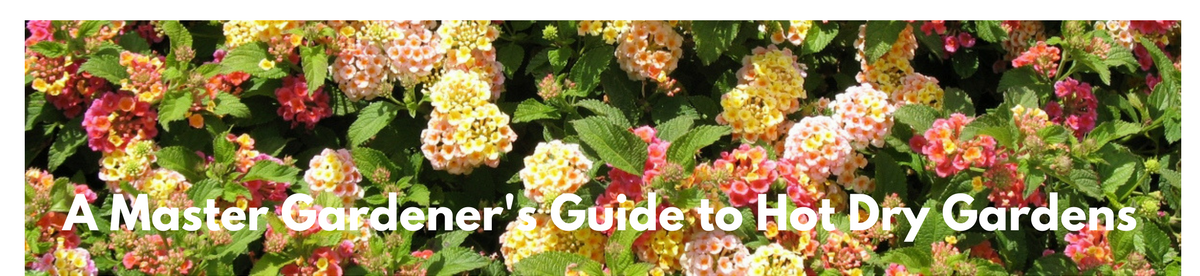
The low-growing Lantana (Lantana montevidensis) comes in many colors these days.

Among the plants in this border near the house are several varieties of Agaves plus Lantana with orange blooms.  Lantana flowers for months on end and needs very little water. The Agaves can survive with almost total neglect.

In the foreground are Aloe, iceplants (Delosperma) and a lone clump of Mexican feather grass (Nassella tenuissima) in bare soil that once had wood mulch on it. The bare soil looks washed out and uneven in contrast to the decomposed granite surface.

Lawn replacement garden #2

This second garden is also drought tolerant, although it definitely needs more watering than the one above.

Drought tolerant garden in late summer hot gardens net
This garden is new within the last 3 years. Wisely, the ground is covered with organic mulch.

Despite the fact that many of the plants are desert natives, they give the impression of being abundant in an almost “English garden” style with mounds of green plants with leaves of contrasting colors and shapes. Because this photo was taken in late summer only a few blooms are left on plants.  Among the plants are the almost leafless Palo verde trees (Parkinsonia x), deer grass (Muhlenbergia rigens), and the Mexican Bird of Paradise (Caesalpinia mexicana) with its long-lasting orange blooms.

The garden design also includes berms, shallow “hills” created artificially, to give more privacy to the home. One good thing about creating berms is that in the process of building up the pile of earth you can add nutrients all the way through to the old bare earth below.  These berms are covered with wood mulch to provide both cover for the bare soil and food for the plants.  The homeowners have chosen a light color decomposed granite for the paths. It also comes in a variety of other colors.

Here is a second view of the home. I’m not sure what the plant in the front by the rock is, but it looks as if it is failing.

I would love to welcome you as a subscriber to Hot Gardens newsletter blog. Please use the form in the upper right side of this page to sign up. 


Where to get a free or cheap tree for your home.


Read our 8 most popular newsletters

  1. Hot Days, White Nights, How Design a Moon Garden
  2. Australian Plants for a Desert Garden
  3. Cover up that naked wall
  4. Best and beautiful native shrubs for extreme heat
  5. Five fragrant plants for your garden
  6. Where to get free or cheap trees for your garden
  7. Four desert trees good for soil, 4 toxic ones
  8. Plants that bloom even in mid-summer scorching heat


Lawn replacement gone wild with blue bottle ornaments

This astonishing landscape design was developed by the homeowner in an upscale neighborhood that is under strict watering limitations. She told me she had no art training so I think of her as a self-taught landscape designer, sort of a “Grandma Moses of garden planning”.

Blue Bottle lawn replacement Hot Gardens net
Encouraged by the water department, this homeowner replaced her lawn with drought tolerant plants and dozens upon dozens of garden ornaments. To one side there is a long row of ornamental  grasses.
Circular Flower Bed in Blue Bottle garden Hot Gardens net
Circles within circles seems to be her main design motif. At night lights surround these plant beds. See below.

Instead of planting an ordinary selection of cactus and succulents, she let her imagination take flight by adding blue bottles, wind spinners and, at night, lights encircling the plant beds. And, from the empty pots and bags of mulch still stacked around the garden it appears she isn’t done yet.

She inspired me to check out garden ornaments on Amazon and I found this attractive wind spinner and some interesting solar lighted lilies.

What do you think of this garden?

Garden ornaments for lawn replacement Hot Gardens net
The homeowner’s love of wind spinners is quite obvious.
Plumeria tree Hot Gardens net
Among all the cactus and succulents is this tropical plumeria tree. It requires more water than most of the other plants. All the plants in this garden appear very healthy.
Blue Bottles fan ornament in Pasadena Hot Gardens net
While the blue bottles are the most conspicuous visually, there are actually many more wind spinners in the garden.
When the homeowner/designer said she had added lights to the garden and invited me to come back after dark to see it, this is what I saw. It is a quite subtle light display.


Where to get a free or cheap tree for your home.


Read our 8 most popular newsletters

  1. Hot Days, White Nights, How Design a Moon Garden
  2. Australian Plants for a Desert Garden
  3. Cover up that naked wall
  4. Best and beautiful native shrubs for extreme heat
  5. Five fragrant plants for your garden
  6. Where to get free or cheap trees for your garden
  7. Four desert trees good for soil, 4 toxic ones
  8. Plants that bloom even in mid-summer scorching heat


Should you plant a palm tree oasis in your back yard?  Maybe…or maybe not

For centuries palm trees have been symbols of comfort and safety whether spied in an oasis from afar in a scorching hot desert or…standing tall as a “land-ho” sign after crossing a vast stretch of ocean or…simply marking the beginning of warm weather country when traveling south in the U.S.

As symbols or signs, palm trees are great. I love seeing them lined up along The Strip in Las Vegas, and Arroyo Parkway in Pasadena and Canon Drive in Beverly Hills. But as for planting a palm tree in a residential garden…I am less enthusiastic.

3 Washingtonia robusta fan palms
Three Mexican fan palms.

Plant a Mexican fan palm (Washingtonia robusta) or a fruitful date palm (Phoenix dactylifera) and within a few years you have a tall, round brown column in your front yard. The graceful green fronds will have grown out of sight and cast very little shade.

The Mexican Fan palm has vicious thorns on its fronds and a prick from one thorn can cause an infection. And if your sky-high date palm produces fruit, the dates will drop and make a mess—albeit a tasty mess—in your yard.

But there are two and a half smaller palm trees that are more suitable for home gardens in hot, dry climates.

Pindo palm California fan palm

The Pindo palm (Butia capitate) has long fronds, like the date palm, but grows very slowly to 20 feet tall and about the same width.  It produces a yellow fruit that in some countries is turned into jelly or wine. It is the smaller palm in front in the photo. Behind it is a Mexican fan palm which is growing its way to 60 feet tall. Both planted at the same time.

Mediterranean fan palm Chamaerops humilis

The Mediterranean Fan palm, (Chamaerops humilis) as the name states, has fan-like fronds similar to the Mexican fan palm, but it is essentially a palm shrub, not a palm tree.  Many people trim the lower fronds off the multiple trunks to give this plant a more traditional “palm tree” shape. A slow grower may reach 15 to 20 feet someday. Its small, brown fruit is not edible.

Both these smaller palm trees can survive chilly weather, even a quick light dusting of snow!

sago palm cycad

And now for the “half palm tree”.  It is commonly called a sago palm, but it is not a palm at all. This low growing cycad is closely related to evergreen pine trees. It can be an attractive addition to a palm garden oasis and grows really s-l-o-o-o-w-l-y. Be sure to plant in a backyard; thieves steal them from front yards regularly because they are very expensive plants. Another note about the sago palm: its bright red fruit can be toxic to dogs and other small animals and is not good for humans of any size.

So even though palms like being planted in warm soil and can be planted in warm weather if watered sufficiently, consider how it will look in a few years. In my opinion, it is better to invest your money and time planting a fast growing Chitalpa tree (Chitalpa x tashkentensis).


working after retirement ebook and paperback

Read our 8 most popular newsletters

  1. Hot Days, White Nights, How Design a Moon Garden
  2. Australian Plants for a Desert Garden
  3. Cover up that naked wall
  4. Best and beautiful native shrubs for extreme heat
  5. Five fragrant plants for your garden
  6. Where to get free or cheap trees for your garden
  7. Four desert trees good for soil, 4 toxic ones
  8. Plants that bloom even in mid-summer scorching heat