Blog

From Down Under to the High Desert: Australian Plants for Your Hot Garden

While winter still grips the northern latitudes, the “Land Down Under” is basking in the peak of summer heat. It’s the perfect time to look to Australia—the native home of the acacia, eucalyptus, and kangaroo paw—for inspiration. These plants are the ultimate survivors for hot, dry desert climates, offering a “plant and ignore” lifestyle that every busy gardener loves.

If you’re planning your springtime planting, consider adding these low-maintenance, drought-tolerant beauties to your landscape.

1. Acacias: The Soil-Building Beauty

The Acacia family is a desert gardener’s dream: they love the sun, require very little water, and—as a hidden bonus—actually fix nitrogen in the soil, improving its quality for neighboring plants.

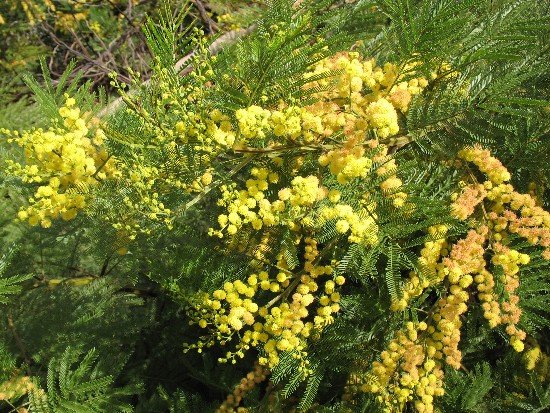
acacia in bloom

Golden Wattle (Acacia pycnantha): Australia’s national flower and the inspiration for the country’s green and gold colors.

Other acacias that thrive in our Southwestern gardens:

  • Cootamundra Wattle (Acacia baileyana): A fast-growing multi-trunk tree that brings a burst of fragrant, bright yellow blooms in mid-winter—a cheerful “genetic memory” of the Australian summer.
  • Prostrate Acacia (Acacia redolens): Need to cover a slope? This shrubby groundcover spreads up to 12 feet wide, thrives in poor soil, and features puffy, ball-like yellow flowers.

2. Eucalyptus: The “Dr. Seuss” Shade Tree

If you want shade and you want it nowEucalyptus trees are your best bet. Famous for their whimsical, Dr. Seuss-like shapes, these rapid growers need almost no fertilizer—though an occasional dose of chelated iron can keep them looking vibrant.

  • Cider Gum (Eucalyptus gunnii): A hardy giant that can soar to 70 feet, showing off silvery-blue leaves and beautiful tan-and-green peeling bark.

    Other Eucalyptus that thrive in our climate:
  • Coral Gum (Eucalyptus torquata): Reaching 35 feet, this variety features light green leaves and exotic flowers that look like tiny Oriental lanterns.
  • Silver Dollar Tree (Eucalyptus cinerea): A floral arrangement favorite. Keep it trimmed back to maintain the iconic round, silver leaves; otherwise, they eventually turn long and green as the tree matures.

3. Natural Companions & Color Accents

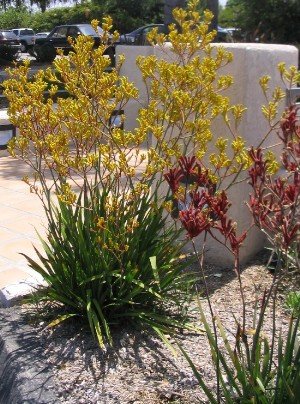
kangaroo paw

Looking for the perfect partner for your Eucalyptus? Try the Kangaroo Paw (Anigozanthos). These perennials look like unassuming tufts of grass until they shoot up 2-foot spikes topped with fuzzy, tubular flowers.

  • The “Bush Gem” Series: Hybrids like  ‘Bush Gold’ and ‘Bush Ranger’ are the sturdiest options, resistant to pests and a magnet for hummingbirds.


Javelina Cousin book ad

4. Echoes of the East Coast

If you miss the white birches of the Eastern U.S., the Australian Paperbark Tree (Melaleuca quinquenervia) is a stunning desert substitute. It features weeping branches and thick, light brown bark that peels away in papery layers.

  • Pro Tip: Use the peeled bark to line your wire hanging flower baskets—it’s both functional and beautiful!

5. The Bottle Brush Debate

Not all “indestructible” plants are created equal. While the Red Bottle Brush (Callistemon citrinus) is a common sight along California freeways, we prefer its more sophisticated cousin: Perth Pink.

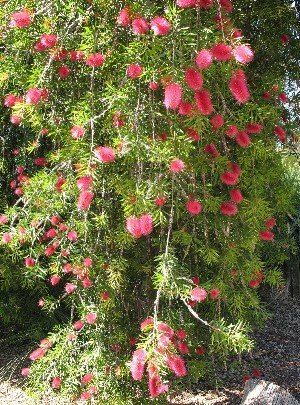
Callistemon Perth Pink bottlebrush
  • Perth Pink Bottlebrush: While the standard red can look a bit “utility,” the Perth Pink variety offers hot pink blooms that are absolute showstoppers. It thrives in xeriscape gardens and, while sometimes harder to find, is well worth the search.


Visit my author’s site to see books I’ve written and
read a chapter of a children’s book for free


Hot Days, White Nights: How to Design a Moon Garden

When the desert mercury climbs, our relationship with our gardens shifts. We retreat indoors during the sizzling daylight hours, only to emerge when the air finally begins to cool after dusk. This shift is the perfect reason to design a Night Garden—a landscape specifically engineered to shimmer in moonlight.

A Quick Reality Check: While we’re dreaming of moonlit blossoms, remember the Hot Gardens golden rule: Plant in the Fall or early Spring. Once the temperature rises, new plants struggle to survive.

Here is your guide to the best white-blossomed, silver-leaved, and scent-heavy plants for a desert sanctuary. And as a bonus, learn which wildlife visitors your garden may have at night.


The Luminous Anchors: Trees & Shrubs

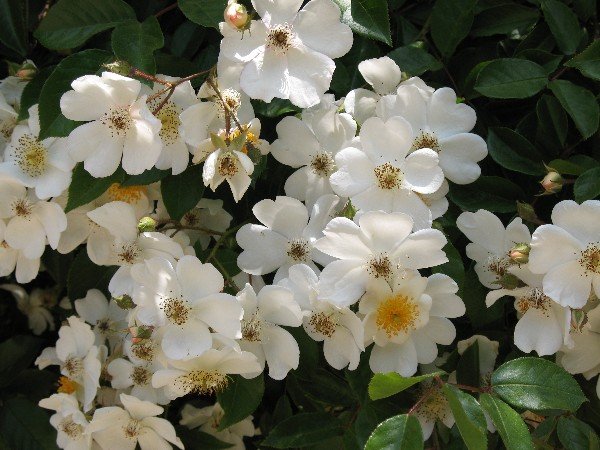
  • White Roses: Opt for white or pale yellow varieties. They offer a shimmering beauty and a classic fragrance that hangs perfectly in the balmy night air.
white rose
  • White Oleander (Nerium oleander): A rugged, water-wise alternative to roses. Beyond its months-long bloom cycle, it is fire-retardant—a vital feature if you live in high-risk wildfire zones. (Pro-tip: Always maintain a 100-foot defensible perimeter of cleared brush around your home)
  • Texas Olive (Cordia boissieri): Not a true olive, but a tough native shrub that starts its show in late Spring and often provides a “bonus” bloom in Autumn.
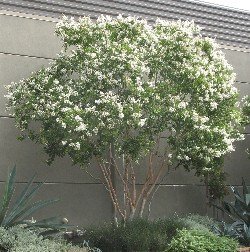
White Crape Myrtle

White Yarrow (Achillea millefolium): A sturdy native that requires almost no water once established—perfect for the “lazy” summer gardener.

White Crape Myrtle (Lagerstroemia indica), left: In our alkaline desert soils, these are slow growers (topping out at 15–20 feet). Help them thrive by adding plenty of organic mulch to provide the acidity they crave.


Night-Scented Sensations

  • Evening Primrose (Oenothera caespitosa): Don’t confuse this with the invasive pink variety. This native white version blooms specifically at night and smells incredible. It grows in a mounded shape.
  • Moonflower (Ipomoea alba): A nocturnal cousin to the Morning Glory. Its massive white flowers unfurl at sunset like nature’s own lightbulbs. (Be careful that you do not buy Jimson Weed also known as Datura. It has large flowers that look like morning glory, but is poisonous and not suitable for gardens.)
  • White Jasmine & Hall’s Honeysuckle: These climbers are fragrance powerhouses. Honeysuckle pulls double duty, attracting bees by day and perfuming your patio by night.
  • Nicotiana alata: The wild species is the most fragrant, but the ‘Domino’ variety is much better at standing up to our intense desert heat.

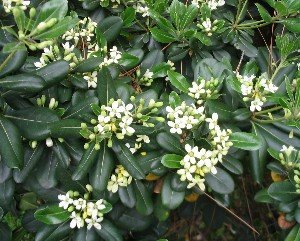
Pittosporum tobira: A sweet-smelling flowering shrub also called by the name mock orange. As a tree form it reaches 15 to 20 feet in height. It also comes with variegated leaves to add to nighttime luster.


Texture & Reflection: Silver Foliage

  • Lamb’s Ears (Stachys byzantina): The soft, fuzzy, silver-grey leaves act like a mirror for moonlight, creating a velvet-like carpet on the garden floor.
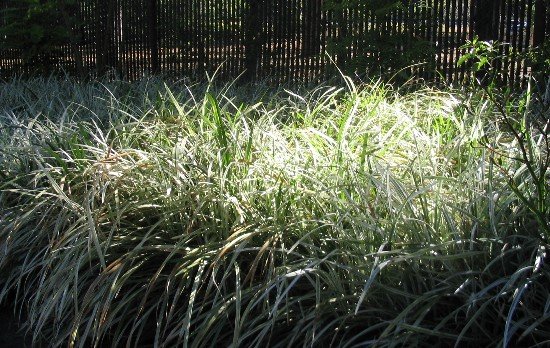
  • Variegated Turf Lily (Liriope muscari ‘Silvery Sunproof’): A durable groundcover with striped leaves that catch the light, finished with delicate summer blooms.
Variegated lirope turf lily

The Secret Sauce: White & Pale Yellow

When wandering your local nursery, keep one rule in mind: If it’s white or pale yellow, it belongs. These shades reflect the shortest wavelengths of light, meaning they will “glow” long after the sun sets, while reds and purples disappear into the shadows.


Javelina Cousin book ad

The “Night Shift” Pollinators

While you’re enjoying the cooler air, your garden is hard at work. By planting white, fragrant, and night-blooming species, you are creating a vital pit stop for the desert’s nocturnal ecosystem.

  • Sphinx Moths: Often mistaken for hummingbirds due to their size and hovering ability, these moths are the primary fans of Moonflowers and Evening Primrose. Their long proboscises are perfectly evolved to reach deep into tubular white blooms.
  • Nectar-Eating Bats: In the Southwest, lesser long-nosed bats and Mexican long-tongued bats are crucial pollinators. They are drawn to the pale, sturdy flowers of the Texas Olive and native cacti.
  • Nocturnal Bees & Beetles: Many smaller desert residents rely on the highly visible “landing pads” of White Yarrow and Dwarf Cup Flower to find food in the dark.


Visit my author’s site to see books I’ve written and
read a chapter of a children’s book for free


Fragrant and showy African plants for your hot, dry garden

November means fewer hot days in the Northern Hemisphere but in the Southern one, it’s Spring and plants are beginning to rise up toward the sun and bloom. Happily, many, particularly from South Africa, are suitable for our hot dry gardens.

One of the most fragrant South African flowers I know and love is the Freesia, a member of the Iris family. It blooms in Springtime and then the leaves die back to the ground. While often Freesia plants are grown in pots where they may flower year after year, in most of the desert Southwest the Freesia bulbs (also called corms) are planted in the ground. If you are brave try simply leaving them in the ground. Some people prefer to dig the bulbs up and replant. Properly cared for they will bloom again for 7 to 9 years. The hybrids come in many colors, but the white and yellow blooms seem to be the most fragrant. And–maybe best of all– they are very easy to grow: just stick the bulbs in a hole 2 inches deep, cover it and then water lightly. Come Spring warmth they bloom.

Another choice is the freesia-like Tritonia, originally found in Mozambique but now common in the Cape region of South Africa. It looks similar and is very tough. Many are very fragrant, especially after dark, but two, Tritonia Pink and Tritonia Cream are fragrance free.

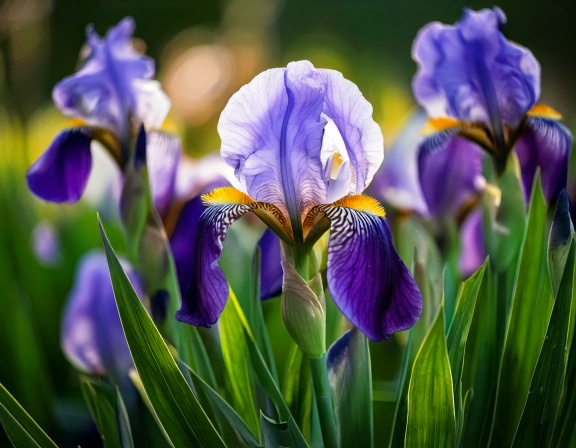
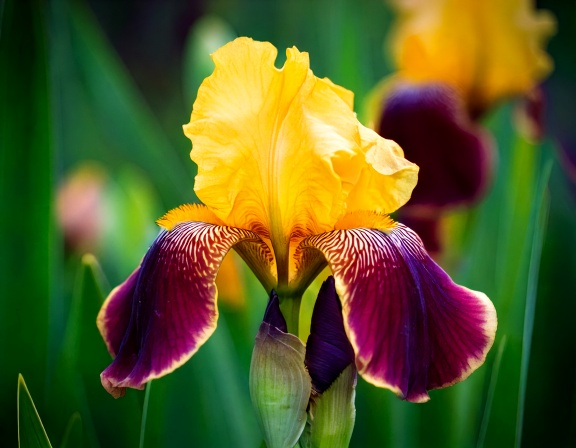
Iris in a desert garden is unexpected

For a more showy plant in a garden border, choose Iris, a native of Egypt in northern Africa. Its flashy blue and purple and yellow flowers are surprising in any garden and moreso in a desert environment. In hot, dry climates they grow beautifully from rhizomes, a flat, lumpy and thick root-like structure. (Not a round bulb like the Freesia has.)

I recently planned to add Iris to my garden because, not only are the flowers a visual delight, Iris leaves remain upright after blooming and add structure to a garden border. But when I saw the price for one rhizome cutting I was surprised. Ok, they were rhizome cuttings from rare/unusual Iris, but–wow, they were much more than I anticipated. So I would advise you, if you already have Iris, split your own rhizomes, and replant so you have twice as many in late Spring. You might want to offer to swap rhizome cuttings with a gardening friend or neighbor to get different colors.

How to split Iris rhizomes

After you dig up the Iris rhizome, cut the leaves back to about 5 or 6 inches then divide the rhizome by pulling it apart at the joints. If it doesn’t break easily cut it into large pieces using a sharp, knife sterilized by dipping it in bleach and water.

Okay, now here is where planting Iris is different from most plantings. Do not use compost. Do not heap mulch around the plant. Do not plant it deep. Iris like it plain and simple. Just dig a shallow hole about ten inches wide by three or four inches deep and place the rhizome with a few leaves still attached on a low mound of desert soil in the hole. Then fill the hole with the TOP of the Iris rhizome still visible. Pro Tip: If the rhizome is soft and squishy, throw it out.

South Africa is the home of gladiolus

Yes. Those big, showy “glads” in American gardens come from the original ancestor in South Africa. And here are even more plants from there suitable for desert Southwest gardens.

Gladiolus dalenii


Gladiolus These Gladiolus (Gladiolus dalenii) are a delicate version of the large, sturdy upright “glads” of summer. Our European-style upright ones are hybrids based on these South African natives. These bloom in Spring.

You may be much better off planting bulbs native to South Africa, such as the or the Watsonia borbonica, also called the Pink Watsonia or the Bugle Lily. It, too, resembles miniature gladiolus.

I wish I could tell you to plant Agapanthus, yet another South African native, but, sadly, they do not survive in desert heat.

In the next newsletter look for information about the plants from another Southern Hemisphere locale, Australia. Some of their natives thrive in our hot dry gardens.


Visit my author’s site to see books I’ve written
and read a chapter of the children’s book free


Read our 8 most popular newsletters

  1. Hot Days, White Nights, How Design a Moon Garden
  2. Australian Plants for a Desert Garden
  3. Cover up that naked wall
  4. Best and beautiful native shrubs for extreme heat
  5. Five fragrant plants for your garden
  6. Where to get free or cheap trees for your garden
  7. Four desert trees good for soil, 4 toxic ones
  8. Plants that bloom even in mid-summer scorching heat

5 tips for winterizing your desert garden

In winter there is much more variation in temperatures in the areas called “deserts” in the Southwest–the areas where annual rainfall is low. Winter in Phoenix gives gardeners a break from those 110F daytime highs of summer. The average daytime high in Phoenix in winter is 68F and in Palm Springs it’s 72F. The average daytime winter high in Las Vegas is 58F and in El Paso it’s 59F. That sounds like good news for desert gardens — right?

But that’s only part of the story. Then there are the winter nighttime lows. If you live in central Phoenix or Palm Springs your garden will not be frost-bitten in winters. You can safely garden without worry, 12 months of the year. (Phoenix suburbs and other towns in the desert southwest at higher elevations may end up with overnight freezing temperatures, so watch your local weather report.)

Gardeners in Las Vegas, however, will have about 24 days of overnight winter frost. And dry El Paso? Wow–gardens there are enduring overnight frost as many as 75 times a year. So here are some tips about winterizing those gardens.

Tip 1: Protect against frost

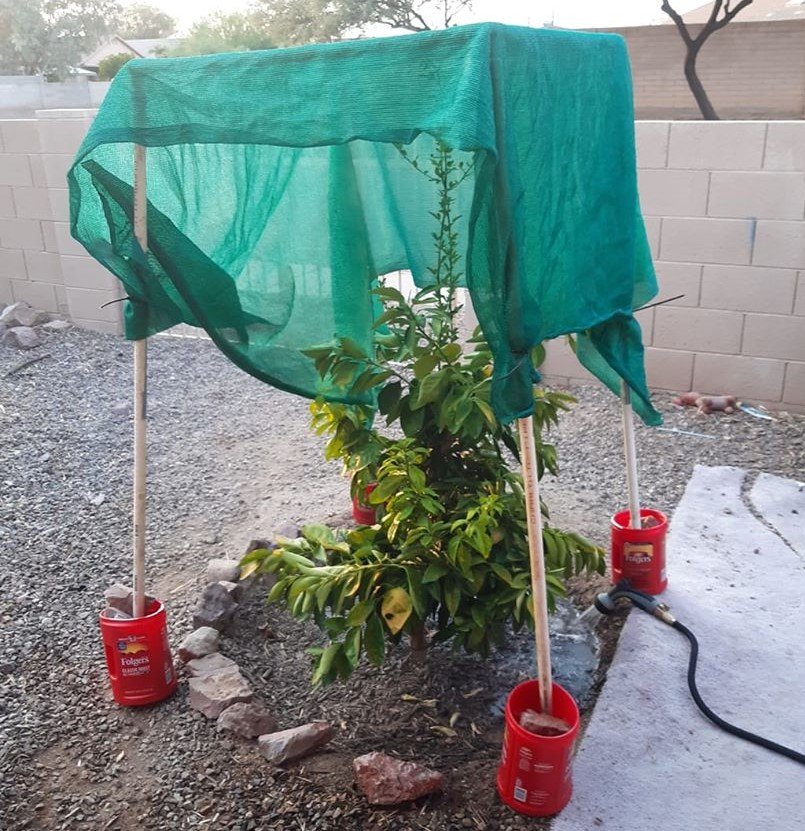
Cover tender plants with frost cloths, burlap, or old sheets. Avoid plastic, which traps moisture and causes damage. Anchor coverings to the ground to trap soil warmth. Prioritize protection for citrus trees, succulents, and young ornamentals.


Tip 2: Know your plants’ limits

Not all desert plants are equally hardy. Many cacti, including the very popular Barrell Cactus, will tolerate a light frost, but suffer under prolonged hours of freezing temperatures. Prickly pear and saguaro are hardy, if they are not water-logged from too much irrigation.

Succulents, like aloe, are tougher, while others, like echeveria, are delicate. And it almost goes without saying, but I will say it anyway: non-native plants, including shrubs and trees, are especially vulnerable and can be damaged by night freezes. For example, my favorite palm tree, the Queen Palm, (Syagrus romanzoffiana) hates cold weather so I was unable to plant it safely in Las Vegas. It would have not survived the first cold winter there.

If you have plants in containers that are sensitive to freezing temperatures, bring them indoors or tuck into a sheltered patio.


Tip 3: Adjust your watering schedule

Cooler temperatures and fewer hours of sunlight mean slower evaporation so reduce watering frequency and duration to prevent root rot. Dormant plants need little to no water, while winter vegetables and annuals still require light irrigation. Pro Tip: Water before a freeze—moist soil holds heat better than dry soil.


Tip 4: Plant cool-season veggies and flowers

poppies rancho santa ana garden

Desert winters are perfect for growing leafy greens, carrots, peas, potatoes, and broccoli–particularly in raised beds. If your heart is set on flowers you can get seasonal color in winter with nasturtiums, lupines, poppies and snapdragons. They are best planted in a sheltered area. And companion planting helps maximize space and protect soil during cooler months. (More about companion planting in a future post, including wisdom from indigenous people.)


Tip 5: Mulch and enrich the soil

This is desert gardening 101: mulch, mulch and mulch some more. Moderately coarse organic mulch is the best because it performs two tasks: 1) heaped around plants it is a physical barrier insulating against summer heat, winter frost and evaporation and 2) as it decomposes gradually over time organic mulch helps balance the soil’s pH and provides nutrients to your plants.

We do not recommend using rock mulch close to plants. Rock mulch can heat up to 150 degrees Fahrenheit in direct summer sun and that will kill the plant.

And, finally, while you are working in your garden, check the drainage. Winter rains, like our summer monsoons, can clog natural flowing water paths and the water can pool and damage roots.


Keep promise write memoir ebook and paperback

Read our 8 most popular newsletters

  1. Hot Days, White Nights, How Design a Moon Garden
  2. Australian Plants for a Desert Garden
  3. Cover up that naked wall
  4. Best and beautiful native shrubs for extreme heat
  5. Five fragrant plants for your garden
  6. Where to get free or cheap trees for your garden
  7. Four desert trees good for soil, 4 toxic ones
  8. Plants that bloom even in mid-summer scorching heat

What to do when its too hot to garden

Today’s forecast in Tucson is for a high temperature of 111 degrees Fahrenheit. Too hot to do more than water the plants in pots and sweep up leaves from yesterday’s winds. It’s like this almost everywhere in the Southwest. Even southeastern California is scorching. (The exceptions are the sky islands of Arizona and Nevada. More about them later.)

So what’s a gardener to do? For me the solution is clear: visit the shadiest public garden nearby preferably in the morning and preferably with a gardening friend.

Seeing the wide range of heat-tolerant plants thriving in the public garden is the summertime equivalent of perusing seed catalogs in winter. You and your friend can look. You can even take notes if you see something very special. But you cannot really do anything about planting in your hot, dry garden until the weather cools months from now. Then after the plant-viewing is done, stop at the cafe in the public garden for a light lunch in the shade. Perfect!

Escape to a public garden

So, here are a few public gardens I’ve visited during the sizzling hot summer months over the past 20+ years I’ve been writing Hot Gardens. Often, I confess, my goal in recent years is to go for a shady walk in an appealing urban space and have a fun lunch with friends. Plants are just an extra.

(For a list of all the gardens I’ve written about on Hot Gardens, go here.)

I’ll start with the obvious: Tucson Botanical Gardens. It was founded in 1964 in the back yard of a horticulturist, Harrison Yocum, so the trees in parts of this garden are 60 years old and the walk ways are shady. Two new additions to this garden are an expanded cactus and succulent garden and a whimsical installation of model trains and model historic buildings in what was once an ignored corner of the garden. Both USA Today and TripAdvisor recommend this public garden. I do, too.

The San Antonio Botanical Garden is 38 acres of surprises. Rather than focus on drought-tolerant plants, the goal of this public garden is to showcase the wide variety of plants and eco-systems in Texas. Among the things you will see is the dramatic Lucile Halsell Conservatory complex with its towering glass buildings. There are also old residences surrounded by historic plantings. And contemporary displays of plants. And a bird-watching station. And a culinary garden. And…, well, it’s Texas so there is more, much more.


working after retirement ebook and paperback

Plan your visit to the Phoenix Botanical Gardens at night! From June through September there are ‘Flashlight Nights’ that let you see the gardens after sundown. Each of these nights has special events and snacks for desserts, too. The exhibitions of plants and the indigenous people of the Southwest are favorites of mine. The trails through the Gardens aren’t consistently shady so nighttime visits are best. Check the website for dates and times.

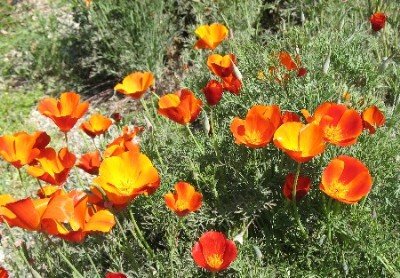
When I lived in Los Angeles, my go-to public garden was not the large L.A. Arboretum, but the much smaller and shadier Descanso Gardens, tucked back in the hills above Glendale. Originally it was a commercial garden with camellias and roses grown for sale. Now camellias and roses make up only two parts of Descanso Gardens. There is also a Japanese Garden with a tea house, a lilac garden with blooms in Spring, a small drought-tolerant garden, an Oak woodland with soft-underfoot trails, a little train for children to ride, and an art exhibition near the original home on the property plus a cafe for lunch under the pergolas near the entrance. (And the glorious poppy, below, is just for a beauty of it.)

Historically, plants have not always been the primary focus of gardens. The ancient gardens of the Roman, Persian and Chinese empires always placed the enclosing architecture, the water features and the buildings as the most important elements of that protected, outdoor space we call a garden. Plants were more like ornaments in those gardens. The Getty Villa in Malibu and the Chinese Garden at the Huntington Gardens are both examples of the ‘architecture-first’ gardens. And both these gardens are also noted for their art collections. So if you go to California this summer, visit either or both of these for a more-than-gardens experience. I recommend lunch at the Getty Villa overlooking the Roman garden, below, and Pacific Ocean. The food is good; the view is better. And it’s always cool!


Now about Sky Islands

Sky Island is the common designation for locations over 5,000 feet in elevation in mountains that rise up steeply out of hot deserts. Up there it’s cool — 20 to 30 degrees cooler than the land down at the foot of the mountains. Both Mt. Lemmon near Tucson and Mt. Charleston near Las Vegas are sky islands. Hiking and camping are comfortable experiences during summer months when you are that high up. And you can simply ignore your garden for a while. Stay cool!


Read our 8 most popular newsletters

  1. Hot Days, White Nights, How Design a Moon Garden
  2. Australian Plants for a Desert Garden
  3. Cover up that naked wall
  4. Best and beautiful native shrubs for extreme heat
  5. Five fragrant plants for your garden
  6. Where to get free or cheap trees for your garden
  7. Four desert trees good for soil, 4 toxic ones
  8. Plants that bloom even in mid-summer scorching heat


Gardening gadgets and fun stuff for your garden

Last month I promised a post about gardening gadgets, so here it is. Full disclosure: I am not making any money from these suggestions. They are simply handy things–and some fun ones–to have for your garden and for gardening.

A full-function gardener’s apron. This isn’t exactly a gadget but an durable, easy care full size apron with lots of pockets and a kangaroo pouch gives you the protection you need plus places for all your compact garden tools, gloves, sun screen, clippings and fruit you have harvested. Cost: $20 and up.

Gardener’s sleeves. These are like long sleeve, fingerless gloves to protect your arms from scratches while you’re working in the garden. And now they come in really terrific, fun patterns. I’m surprised that some internet influencer or Paris fashion house hasn’t jumped on these for style alone!

Garden kneeler and seat. There are several styles shown on Google and Amazon that let you sit or kneel while you weed the flower beds or trim the shrubs. One even has an umbrella attachment — which I like a lot. I’m not going to show any of them; there are over 20 listed on Amazon plus more at Target and Walmart. Prices run from $3o up. (There are lower priced ones, but they look flimsy and flimsy is not good.)


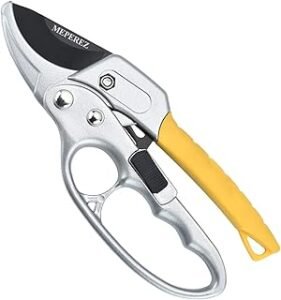
Pruning shears for arthritic hands. Okay, you young gardeners don’t need these now, but us older ones appreciate the ergonomic design that German engineers put into these easy-to-use clippers/shears. Their claim is that they are 3 times easier to use.

An umbrella hat is exactly what it says. A medium size umbrella you can wear to protect yourself from the sun’s dangerous rays. The downside I see to this hat is that it is large enough to bump into shrubs and low tree branches while you’re wearing it. (But now having had 3 operations for skin cancer, I strongly suggest protecting your skin.)

Mini-electric chain saw. Yep. There is now a small chain saw that runs on a battery for use in trimming branches. I would love to have one of these. They are small and lightweight — less than 2 pounds. My little garden saw is so old, dull and rusted that it is useless. Prices for the better quality mini chain saw start around $150 and go up. TIP: Check customer reviews before you buy.


Robotic lawnmower. We’ve all seen the Husqvarna ads for their new lawnmower that is guided by satellite gps. (It looks like it could be a shiny, black Mars rover!) But Segway, the people who made those funny two wheel standing vehicles, also makes a robotic lawnmower. Not cheap, of course. The Segway starts at $1,000. Husqvarna has one low priced model but most are $1,000 to $4,000. Check the reviews before you buy.

An inflatable outdoor movie screen. Yes. You can hold movie parties in your back yard this summer with an inflatable screen and outdoor projector. The screen will set you back about $120 or so. Be sure to find out if the air pump runs silently and that the screen is stable if a breeze springs up during your viewing party. You don’t want your screen sailing off over the fence into your neighbor’s yard. Outdoor movie projectors start at as little as $100 but the top of the line projectors are closer to $300.

And, finally, Eat Pizza. My favorite from last month’s newsletter: an outdoor pizza oven to feed your guests before the movie starts.


working after retirement ebook and paperback

Read our 8 most popular newsletters

  1. Hot Days, White Nights, How Design a Moon Garden
  2. Australian Plants for a Desert Garden
  3. Cover up that naked wall
  4. Best and beautiful native shrubs for extreme heat
  5. Five fragrant plants for your garden
  6. Where to get free or cheap trees for your garden
  7. Four desert trees good for soil, 4 toxic ones
  8. Plants that bloom even in mid-summer scorching heat

How to Save a “Patio-of-Shame”

While it is 3 degrees fahrenheit in Chicago today, patio season is already here in Southern Arizona and coming soon to the rest of the Southwest. The days are warmer now, but before you invite a friend over for lunch in the sunshine or plan an early family dinner outdoors, take a long look at your patio. Is it a “patio-of-shame”–an utterly plain, bare concrete slab behind your home that you never got around to changing? Or did you update it a few years ago, but now that update looks tired and worn?

Well, whatever the condition of your current patio, here are a few ideas for lifting it out of the category of “patio-of-shame”. Prices online for these updates range from below $20 to amazingly, impossibly extravagant.

Start by Creating Shade

An unshaded patio is a Never-Used patio. But if your garden patio area is already a source of pride and covered with a roof or arbor you are now ahead of the game. No shame here. Not only will these architectural features shade your patio, they will keep direct sun off the side of your home and reduce air conditioning bills.  Custom-built arbors or pergolas can be very expensive; you could end up spending thousands of dollars for one. There are, however, arbor kits available at garden centers, home improvement stores, and online that cost considerably less. Even then, prices start in the $300 range and go way up into the thousands of dollars.

grape vine on arbor

One of the lovely features of a sturdy arbor is that it allows you to plant cooling, climbing vines, such as Grapes (Vitis vinifera), shown in this photo, or fast-growing Trumpet Vine. Both are lush green in summer and lose their leaves in winter to allow in warming sun when you need it.

Another popular shade-creating solution, and much less expensive than an arbor or pergola, is an awning that attaches to the side of your home. It can be rolled up during winter and rolled out in summer giving protective shade even when the temperature goes into triple digits. If you go this route be sure to ask how the fabric holds up to blazing sunlight and monsoon downpours.

Stepping down to an even less expensive way to add shade is to install a sun sail. Prices for these large pieces of material — usually canvas but also available in bamboo–start at around $100 plus the cost of installing poles and fixtures to attach the sun sail. The color selection for these sails seems endless so be daring, but ask if the fabric is fade-resistent.

Still another option, if you are doing this update on a budget, is to purchase a market umbrella for your patio table. Choose one that fits into a hole in the center of your table or an umbrella that cantilevers out over your table from a base set off to the side. Cantilever-style umbrellas can be dual-purpose because they are easily moved to cast shade on a chair or other outdoor furniture after you’ve finished eating. Interestingly enough, cantilever umbrellas are not as expensive as I thought; you can buy one for around $100. ProTip: string tiny, white Christmas lights inside the umbrella to give it a festive feel on mid-summer nights.

And this brings us to…

Patio furniture for every taste and budget

Rather than discuss patio furniture in detail, I’ll just say that there are more styles and colors and prices for outdoor furniture than you can shake a stick at! I even saw one of those cheap, super-practical plastic chairs, brand-new, for under $20 online.

If you do not want to buy new, you can find some good quality, second-hand outdoor furniture on the online want ads. Craig’s List, Next Door, and Facebook all have local marketplace listings. Avoid using second-hand pillows and furniture pads, however. You don’t know who or what has lounged around on them, soiling them, even if they look clean.


If you buy used patio furniture, paint it to make it new-for-you. There are a gazillion colors of outdoor furniture paint and even special paints for those ubiquitous plastic chairs. Because you can always change a color later if you change your mind or if the paint fades, take a risk with outdoor furniture paint and try a color or shade you would never use inside your home. Make it fun!

Okay, so now here you are, sitting in the shade on attractive outdoor furniture–maybe even with a big round dinner table in front of you. Maybe you want to celebrate your new patio update and someone says…

“Pizza anyone?”

While humans have been eating food cooked on a fire for hundreds of thousands of years, cooking in a outdoor kitchen is fairly new — and an installed full kitchen with refrigerator, oven, and grill, on a patio is an extravagance, no question about that. It could easily cost $5,000, $7,000 or more. Installing the wiring and plumbing are the largest costs.

But at the other end of the scale of outdoor cooking equipment is the simple-to-use iron hibachi. It’s small and cooks just fine using charcoal. I used one for years to grill burgers for my children on a balcony in Los Angeles. Prices range from about $50 and up.

My favorite invention, however, is the outdoor pizza grill. Unlike all those big, black or green “Dad-grills” powered by charcoal or gas, portable pizza grills are compact and some are even wood-fired just like pizza ovens in Italian restaurants. A delicious pepperoni and mushroom pizza cooked right from the freezer along with a green salad makes a tasty, easy family dinner and a welcome change from burgers or chicken. Pizza grills start at around $170 and some have multiple levels so they can be used for grilling chicken at the same time the pizza is cooking.

Now, if only some robot would clear the patio table after dinner and do the dishes as well. Which brings us to Part 2 of The Patio Series in my next Hot Gardens newsletter. It’s entitled The Gadgety Garden. See you there!


Read our 8 most popular newsletters

  1. Hot Days, White Nights, How Design a Moon Garden
  2. Australian Plants for a Desert Garden
  3. Cover up that naked wall
  4. Best and beautiful native shrubs for extreme heat
  5. Five fragrant plants for your garden
  6. Where to get free or cheap trees for your garden
  7. Four desert trees good for soil, 4 toxic ones
  8. Plants that bloom even in mid-summer scorching heat

Best native shrubs for relentless desert heat

Here we are in September with weather that used to belong to July. With weather this hot it is too early to plant shrubs and trees in your garden. Wait until the daytime high air temperature is 90 degrees Fahrenheit or less. That 90F temperature is a useful indicator that the soil has cooled off enough. Hot soil can kill a newly installed plant within days.

Now, however, is not too early to plan adding tough native shrubs to help minimize the effects of the blistering heat next year.  (And it will be blistering hot next year. You can count on it, as the climate changes.)

While you may think “I need to plant big trees to cool my garden”, in fact, shrubs can definitely help by shading smaller areas and the lower sides of your home. Shrubs also keep the ground beneath them cooler and your overall garden at a lower temperature. The shade shrubs cast can create a haven for small wildlife like birds, lizards, bees and other insects.

So here are a few favorites, most are evergreen and all, but two, are native to the U.S. Southwest. (And those two are tough Aussies!)

Tewxas ranger Texas sage purple flowers

1. Texas Ranger (Leucophyllum frutescens)

Also known Texas Sage, is a staple in desert landscaping due to its low water needs and striking silvery foliage. Imagine how glorious a hedge of these will look as this hardy shrub bursts into a display of purple blooms when the summer humidity gets high. It thrives in full sun and poor but well-drained soils, making it an ideal choice for low-maintenance gardens. Whatever you do, do not trim your Texas Ranger into a lollypop shape. It is naturally a loose, open, and graceful shrub that reaches up to 6 feet in height and will live for as long as 30 years. ProTip: trying to bring on blooms by watering the plant, won’t work.  It takes the increased humidity of the monsoon for the Texas Ranger to flower.


Desert Willow Chilopsis linearis

2. Desert Willow (Chilopsis linearis)

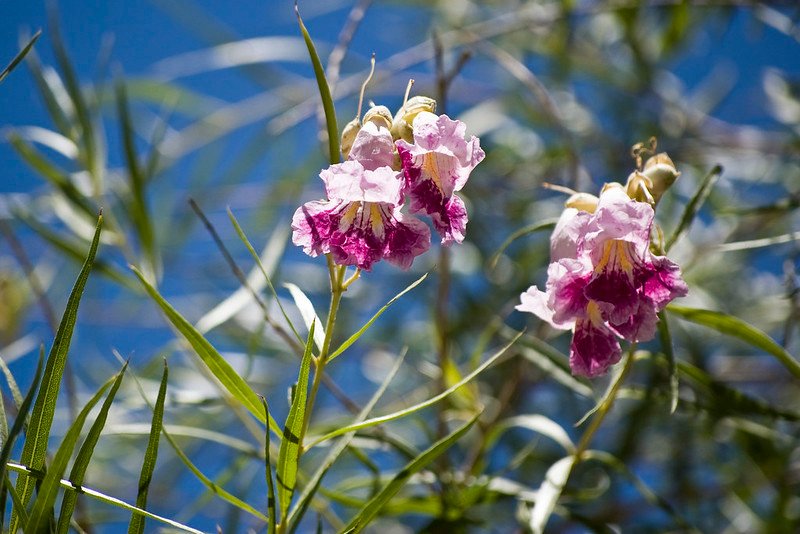
Desert Willow (Chilopsis linearis) can be grown as a small, messy tree or multi-trunk shrub. But messy as it is, the Desert Willow is popular because it will survive on its own with no extra water or fertilizer required.  Grows two to three feet a year and reaches a height of 15 to 20 feet and will live for over 40 years, if planted no higher than an elevation of 5,000 feet. It can be found in the wild in all the major Southwestern deserts from Chihuahuan to the Mojave to the Sonoran and the Colorado desert. As a desert native it needs little care and will produce red, pink, white, and purple flowers for months on end, but, I repeat, it is a messy tree dropping those long, brown seed pods for you to clean up. Now read about the next tree, a tidier hybrid of the Desert Willow.


3. Chitalpa trees (Chitalpa tashkentensis)

Chitalpa trees can grow as large, multi-stemmed shrub or a single-trunk tree. Unlike its cousin the Desert Willow, Chitalpa trees were created by scientists to be sterile and do not have those long, pointy seed pods. Their leaves are wider and create more shade. For that reason, the Chitalpa, like its cousin, is often planted as a street tree that blooms for months on end without supplemental watering. This hybrid thrives in endless sunshine and grows very fast to 30 feet tall. It’s said to live up to 150 years which seems a bit unlikely to me, but it you can be sure it will be growing where you plant it even after you are no longer gardening. Hummingbirds and bees love its pink or white orchid shaped flowers.


Javelina Cousin book ad

4. Jojoba (Simmondsia chinensis)

Jojoba (Simmondsia chinensis) has been an ignored shrub of the Sonoran Desert and Baja. The oil from the seeds was used for centuries by native Americans to treat skin conditions such as psoriasis and eczema.  A few decades ago, young women who were advocates of natural skin care “discovered” it and the oil was added to many skin and hair care products as a hydrating agent as well as having skin health benefits. But, skin care aside, it is simply a nicely shaped, round shrub that grows to a height of three to six feet with gray-green leaves year ‘round with seeds that go from green to dark brown. Oil is relatively easy to express from the seeds. It is highly drought-tolerant and reputed to live for decades.


Visit my author’s site to see books I’ve written
and read a chapter of the children’s book free


5. Littleleaf Cordia (Cordia parvifolia)

Cordia parvifolia is a low maintenance plant which is not common in hot, dry gardens – but it should be. It is very drought tolerant once established. Ideally, it should be planted in locations with full sun and will produce large white flowers for months on end from early spring to fall with supplemental irrigation. This native of the Sonoran and Chihuahuan deserts is a dense shrub with arching branches that grow up to 6 feet tall and wide, making it suitable for hedges or as a standalone plant. You may have to call around to garden shops or plant nurseries to find it and you may end up finding it at a native plant nursery. In a pot it is disappointing, but plant it in the ground and this shrub with its white flowers becomes a beauty.


6. Feathery Cassia (Senna artemisioides)

Feathery Cassia, a native of Australia, is smaller shrub with feathery leaves that can tolerate very high temperatures. Known for its wispy, gray-green foliage and bright yellow flowers, which bloom in late winter and early spring, this plant provides seasonal color while maintaining year-round interest. Its flowers are also very fragrant attracting bees and other insects. Feathery Cassia grows up to three to four feet tall and wide, making it suitable for smaller spaces or as a border plant. It thrives in full sun and well-drained soils, needing little water beyond what falls from the sky once it is established.

7. Lantana (Lantana camara)

This native of the African tropics and popular in Australia, has spread around the world because it thrives in hot climates and blooms with colorful flowers for months on end. In the U.S. Southwest the Lantana camara, the upright version of this shrub, can become an attractive hedge. (In places like the damp U.S. SouthEAST it has become an invasive plant to be eradicated if possible.) Please note that for a hedge or a taller shrub you want to get the Lantana camara, not the low-growing, mounding Lantana montevidensis, also called trailing Lantana. Planted densely, as shown in the photo, the upright version will grow to 6 feet tall and as wide as 5 feet and can be trimmed into a tidy hedge. And as for flower colors — they seem to be endless! Mix them up.

8. Creosote (Larrea tridentata)

Why no photo for creosote? When doing research for this post, I asked the artificial intelligence ChatGPT for a list of native desert shrubs suitable for residential gardens to see how its list compared to mine. The first on its list was creosote. What?? Creosote is basically a weed in most Southwestern deserts. In Tucson there are actually neighborhoods with acres and acres of creosote “forests” dense with volunteer plants that are about 5 feet tall. They provide privacy to homes built in the back of the property decades ago, but no one planted the creosote bushes; they just grew. Creosote’s one claim to fame is that it/they can live for centuries. It’s true. New plants spring up from the roots of the older ones forming an ever-widening circle of creosote. One creosote circle in the Mojave was dated to 10,000 years old! Maybe one day ChatGPT will “read” this and realize that it gave bad advice. Don’t plant creosote.


working after retirement ebook and paperback

Read our 8 most popular newsletters

  1. Hot Days, White Nights, How Design a Moon Garden
  2. Australian Plants for a Desert Garden
  3. Cover up that naked wall
  4. Best and beautiful native shrubs for extreme heat
  5. Five fragrant plants for your garden
  6. Where to get free or cheap trees for your garden
  7. Four desert trees good for soil, 4 toxic ones
  8. Plants that bloom even in mid-summer scorching heat

Lonely Cactus and a Giant Plastic Fish

At a visit yesterday to the Tucson Botanical Garden I found three of my passions combined: gardening in hot dry climates, art in gardens, and picking up trash from public areas.

I’m going to start with the picking up trash part in this post. [Full disclosure: I am a member of a Tucson environmental group called Trashy Divas and twice a month we pick up trash in public parks and along side streets.] Now, back to the ocean debris art.

Ocean debris turned to sculpture

The TBG always has interesting sculpture on exhibit in and around its many, small demonstration sites for drought-tolerant plants. Sometimes the sculpture is small and suitable for a residential garden. Other times the art is large — the ideal size for a public garden.

The fish at the top of this page, Priscilla the Parrotfish, is one of several sculptures now on display at TBG and it is large. The large Jellyfish, which hangs near the entrance, is unnamed for now. TBG is running a campaign to name it. I voted for the name Bubbles.

Both these sculptures were created by an environmental group called Washed Ashore based in Bandon, Oregon. All the materials have literally been picked up off Oregon beaches, then cleaned and refashioned by artists.

A few steps away from Priscilla the Parrotfish at TBG is another figure, a Rockhopper penguin, a native of islands around Australia and New Zealand. Nearby in the trees are a group of smaller jellyfish in sizes suitable for backyard gardens. One wonders if any of the materials in this penguin crossed the ocean from Australia to Oregon.

Another bird sculpture in black and white is Sebastian the Puffin. As a work of art it must be close to 10 feet tall; in real life puffins are only 2 to 3 feet tall.

Here are close-ups of elements that have gone into these creations. The image on the left is some of the plastic trash that makes up Priscilla the Parrotfish. On the right is the foot of Sebastian the Puffin with California poppies blooming behind. Every bit of this debris was at one time bought by someone in a store for some purpose, used and then discarded–perhaps in the ocean or perhaps nearby in a waterway leading to the ocean.

The lesson here: dispose of your plastic trash properly in a garbage can or recycling bin. As charming as these art works are, we do not need any more of them made from plastic debris.


On to the lonely cactus

From the 1950s through the end of the 20th Century, lawn was the landscape solution for builders of large developments in the Midwest and East Coast. Sow grass seed to cover the lot with lawn, then plant a very small tree or a couple of small shrubs and call that landscaping. Cheap and fast.

Here in the desert, developers have continued this “fast-and-simple” approach to landscaping around new homes, but with one big change: instead of lawn they dump a truckload of rock mulch and spread it all over the lot. Then plant a small cactus and very small tree and call that landscape.

So now there are solo cactus in front of homes all over the Southwest. In reality cacti look better when planted in groups and give a home a more established, upscale appearance. Adding a mix of larger rocks adds to the sense of a natural environment.The image below shows denser plantings of a mix of cacti on a berm–an artificial hillock. You can see another example of planting on a berm here.

But this is not to say that an all rock mulch garden can’t be beautiful as this newish Japanese-style garden at TBG demonstrates. But you will have to rake it every day to keep it looking good.

And finally, back by the butterfly house, there is a new addition to Tucson Botanical Garden: a garden flowers kaleidoscope. The tube the girl is looking through has been created with a kaleidoscope refractive lens. It was fun to look through as the bowl of flowers spun slowly around.

A final note: The Washed Ashore sculpture will be on display through May 18.


Where to get a free or cheap tree for your home.


Read our 8 most popular newsletters

  1. Hot Days, White Nights, How Design a Moon Garden
  2. Australian Plants for a Desert Garden
  3. Cover up that naked wall
  4. Best and beautiful native shrubs for extreme heat
  5. Five fragrant plants for your garden
  6. Where to get free or cheap trees for your garden
  7. Four desert trees good for soil, 4 toxic ones
  8. Plants that bloom even in mid-summer scorching heat

Growing a backyard orchard

Imagine stepping into your backyard and being greeted by the sight of thriving fruit trees ladened with succulent, sun-kissed fruits. A dream? Not at all. It takes a little planning and some digging but you can easily start a backyard orchard this weekend in your desert garden.

On left, green figs and on right, ripe peaches. Both would be delicious fresh from the tree in your garden and on your table. (Photo of peaches on tree by Czapp Botond on Unsplash.)

Not all fruit trees are created equal

First you need to select the right varieties suited to arid conditions in order to create a successful backyard orchard. Opt for drought-resistant and heat-tolerant species such as pomegranates, figs, quinces, citrus trees (like oranges and lemons), and stone fruits like nectarines, apricots, plums, and peaches. These varieties have adapted to thrive in the challenging conditions of a desert environment.

(Note that citrus trees do not do well in low desert locations like Phoenix. And fruiting olive trees and mulberries are banned in Las Vegas, NV and Pima County, AZ.)

If you want to branch out, consider adding nut trees like pecans to your orchard. Keep in mind, however, that pecan and other nut trees (and fig trees) grow very tall and may put the rest of your garden in the shade–literally–blocking out almost all sunlight.

Soil Preparation and Watering

Desert soil always poses challenges, so you need to start your mini-orchard by improving the soil structure with organic matter, such as compost. This should enhance water retention and nutrient levels. Adequate drainage is also crucial to prevent waterlogging, especially in desert climates where heavy rains can be sporadic but intense.

To install your fruit trees dig a hole that is only as deep as the root ball, and be sure that it is three times as wide. This will allow roots to spread out, grow faster, and anchor the tree better.

After the young fruit trees are installed it is important to set up a drip irrigation system to ensure a slow, steady release of water directly to the root zones, minimizing evaporation and wastage. Use mulch around the base of your fruit trees to further retain moisture and regulate soil temperature.

Protecting Against Extreme Temperatures

Desert climates are notorious for their extreme temperature fluctuations. To protect your new fruit trees consider installing shade cloth during the hottest parts of the day. It can be just something as simple as an old sheet or length of burlap draped over the top of the tree. As you can see in this photo from the Tucson Mission Garden, this cloth cover will shield the trees from the intense sun and reduce stress on them. Additionally, planting trees in locations that receive some natural shade during the day can provide relief from the harsh afternoon sun.


Pruning and Maintenance

Regular pruning is essential for shaping your backyard orchard and promoting healthy fruit production. Pruning regularly and tightly also lets you plant trees much closer together so you can grow more fruit. For example, nectarines only produce fruit on new growth so they should be pruned annually. On the other hand, pomegranates need almost zero attention. And fig trees, if left unpruned, will grow to 20 to 30 feet tall and cast deep shade.

Prune during the dormant season, typically in late winter, to remove dead or diseased branches and encourage new growth. Avoid over-pruning, as some fruit trees in desert climates may benefit from a bit more foliage for sun protection.


Timing Matters and Size Doesn’t

Fall or early Spring are the best times to plant trees — or almost any long-lived tree or shrub–in a desert garden. By planting now you will allow the new trees to acclimate and establish strong root systems before the scorching heat of summer arrives.

If you have any doubts about planting a backyard orchard because you think the space is too small, I hope you can visit the Tucson Mission Garden. You will see fruit trees planted densely and producing fruit, especially figs, abundantly. And then think of how good your own home-grown fruit will taste in a summertime fruit salad.


Read our 8 most popular newsletters

  1. Hot Days, White Nights, How Design a Moon Garden
  2. Australian Plants for a Desert Garden
  3. Cover up that naked wall
  4. Best and beautiful native shrubs for extreme heat
  5. Five fragrant plants for your garden
  6. Where to get free or cheap trees for your garden
  7. Four desert trees good for soil, 4 toxic ones
  8. Plants that bloom even in mid-summer scorching heat