
Fixing that neglected side yard

It’s long. It’s narrow. And a home’s side yard is usually given little attention. Perhaps the original builder or an earlier owner spread a layer of rocky mulch on the soil and added a few stepping stones along the unused passageway from the front to the back of your home. But often it is not even considered part of the garden.

I have to confess that I ignored my current home’s side yard. A previous resident had, in fact, covered the 10 foot wide strip with reddish brown rock mulch. No stepping stones, however. There are pockets of grass where baby Mourning Doves huddle together and, in another corner, one rugged, volunteer Lantana plant survives. On one side of this passageway is a 6 ft. tall wood fence and on the other, the pale, sand-colored stucco wall for my living room. No windows — thank goodness.

Then, one day this last summer when it was once again 110 degrees fahrenheit outside here in Arizona I realized how much cooler that side of my home–the south side–would be if I planted something tall and shady there–a tree that was very drought resistant and wouldn’t die in relentless 100F+ heat.

Two drought tolerant trees for shade

My first thought was to install a Palo Verde tree in late October or November, when Fall planting season starts. I love this Arizona native’s brilliant yellow blossoms in April but once the flowers are gone, it would only provide a light screen effect with its leafless branches. Not much help countering the blasting sunlight in summer.

Then, I thought, what about another favorite of mine, the long-blooming Chitalpa (Chitalpa x tashkentsis)? Its branches would be ladened with pink flowers for months on end. And Chitalpa trees have leaves to cast more shade than the Palo Verde. Better yet, they grow fast and are so tough that in Las Vegas and Tucson they’re planted as street trees.

But I had to face reality: the passageway is only 10 feet wide and both the Palo Verde and the Chitalpa should be planted a minimum of 15 feet away from the side of a house.

So, a tall, skinny tree was called for–like an Italian Cypress (Cupressus sempervirens) which I know grows in Los Angeles and the Mojave desert. I haven’t seen many of them here in Sonoran desert gardens. A friend in Vegas planted a wall of them but looking at her garden now, maybe that is not the solution–especially when I check the price for 5 or 6 trees. I’ve been told that they suffer from red mites and if not watered deeply they will die.

Thanksgiving and cooler weather arrived and I stopped thinking about shady trees for my side yard. But in that doldrum week between Christmas and New Year, I began to consider it again.


Tough shrubs are a shady solution

Shrubs, I decided. Big, leafy, drought tolerant shrubs–maybe 5,6 or 7 feet tall–planted like a wall of shade next to the house. They will never grow tall enough to shade and cool the roof, but drought tolerant shrubs could block some of the blasting sunlight heating up the stucco. (Yes, Yes, I know I wrote about shrubs to cool concrete block walls last January. I’m now following my own advice.)

lantana hedge in Pasadena

Texas rangers (Leucophyllum frutescens) and upright Lantanas (Lantana camara) immediately came to mind. Both bloom often throughout the year, usually after some rain falls.

With some strategic trimming colorful Lantanas, like the ones in a hedge in Pasadena, can be encouraged to grow to 5 feet high. The Texas Rangers, however, I plan to leave untrimmed. I hate what commercial “gardeners” do to these beautiful, loose shrubs: whacking them into a lollipop shape with most of the lovely purple flowers cut off.

I’ll plant in February when we have had more rain and the soil is beginning to warm up. Now to figure out what to do to my back yard where a neighbor’s small tree died last year. It shaded both our yards and cut off the view from two homes behind us. Maybe that’s the right place for a Palo Verde or Chitalpa. I’ll let you know.


Read our 8 most popular newsletters

  1. Cover up that naked wall
  2. Australian Plants for a Desert Garden
  3. Potmen for a fun DIY addition to your garden
  4. Best and beautiful native shrubs for extreme heat
  5. Five fragrant plants for your garden
  6. Four desert trees good for soil, 4 toxic ones
  7. Plants that bloom even in mid-summer scorching heat
  8. Where to get free or cheap trees for your Western garden

Should you get gardening advice from an A.I.?

You’ve probably already heard about ChatGPT, the new artificial intelligence program by OpenAI that is being called “scarily good.” Well, okay, I thought, maybe it is scarily good about techy stuff but how good is it with gardening advice? So I asked it this fairly basic question.

chlorosis shrub leaves

What causes plant leaves to turn yellow with green veins?

Here is what ChatGPT answered:

“Leaves on plants that turn yellow with green veins is a condition known as chlorosis. Chlorosis is caused by a lack of chlorophyll, which is the pigment that gives leaves their green color. The green veins on the leaves indicate that the plant is still producing some chlorophyll, but not enough to fully color the leaves.”

Okay — so far so good, I thought. And it continued…

“There are several causes of chlorosis, including:

  1. Nutrient deficiencies: A lack of iron, manganese, zinc, or other essential nutrients can cause chlorosis. This is often due to a lack of these nutrients in the soil, or a pH imbalance that makes it difficult for the plant to absorb them.
  2. Disease: Some plant diseases can cause chlorosis, such as leaf spot or rust.
  3. Pest infestations: Pests such as spider mites or aphids can suck the sap from the leaves, causing them to turn yellow.
  4. Environmental factors: Extreme heat, cold, or drought can stress plants and cause chlorosis.”

Item 2 is where ChatGPT begins to slip off the track. Leaf spot or rust do not look remotely like chlorosis; they are orangy yellow round spots on leaves not yellow leaves with green veins. Spider mites and aphids can damage plants but the effect is also spotty leaves–smaller spots–not leaves yellowing.

Then Chat GPT goes for the solution:

“To fix this issue, you need to find the root cause of the problem and take appropriate action. A soil test can help you determine the pH and nutrient levels in your soil and make recommendations for correcting any imbalances. You can also consult with a local nursery or botanical garden for help identifying and treating any diseases or pests that may be affecting your plants.”


That’s where ChatGPT ends.

My conclusion is that it offers basically good advice–as I did in an earlier post about yellowing leaves. But it falls short of the detailed information I wrote about, including short term, fast fixes to out-of-season yellowing leaves. ChatGPT clearly hedges its bet by suggesting that one should consult with a real local human being. (Or maybe a Master Gardener!)

Is ChatGPT trustworthy?

OpenAI, the company that developed this A.I. warns not to trust what ChatGPT says completely — that it sometimes just makes things up. This is a failing of other artificial intelligence programs, too. My guess is that it doesn’t want to appear ignorant — which, of course, opens the question about whether an artificial intelligence computer program can behave as if it is embarrassed by a lack of knowledge — but that is for another blog. Not this one.

I have another gardening question for ChatGPT — one that should be more challenging, but, unfortunately, the Open AI website is so busy that I haven’t been able to get on it again. I’ll report about it, if I can talk with it again.


Read our 8 most popular newsletters

  1. Cover up that naked wall
  2. Australian Plants for a Desert Garden
  3. Potmen for a fun DIY addition to your garden
  4. Best and beautiful native shrubs for extreme heat
  5. Five fragrant plants for your garden
  6. Four desert trees good for soil, 4 toxic ones
  7. Plants that bloom even in mid-summer scorching heat
  8. Where to get free or cheap trees for your Western garden

For goodness sakes, cover up that naked wall

Okay, you removed that thirsty grass in your front yard. You’ve also planted a tree or two or three around your home, shading at least part of your yard and the house, reducing the temperature. But off to the edge of your property–if your home is like most in the U.S. Southwest–is a dreaded gray concrete block wall.

That wall, if left bare, is a heat magnet. Nakedly exposed to direct sunlight the concrete absorbs heat during the day, even on cool days. Then after sundown, the wall releases the heat into the air creating a pool of warmth surrounding your home — just when you’re trying to cool things off at days end. And as the climate changes the wall-heater effect will only grow more intense. So what’s a smart gardener to do?

4 ways to help walls keep their cool
pomegranate fruit on bush

Plant shrubs in front of the wall. In one of my gardens I planted a row of the “Wonderful” variety of pomegranates (Punica granatum). These fast growers will reach a height of 6 to 10 feet. You may want to keep them trimmed to match the wall height because they can reach twice that height. Pomegranates need very little water. A special bonus with pomegranates is, of course, the fruit you can harvest in the late summer. In Fall the leaves turn a lovely shade of yellow before they drop. If you do not harvest the fruit you will have shrubs with bright red “ornaments” on them during the holidays. To see other shrubs for hot dry gardens, go here.

pampas grass hiding a wall

Plant tall grasses in front of the wall

On another wall in the same garden, a previous owner had planted Pampas grass (Cortaderia selloana). After a summer’s growth Pampas grass will be 8-10 feet high plus another 5-6 feet of seed plumes. And it does all this with little need for irrigation or fertilizer. By mid-winter, this perennial should be cut back to 18 inches tall. Be sure to wear gloves and a long sleeve shirt when you cut it back because the leaf edges are rough and serrated. It will re-grow to the same height in the following summer. 

Avoid planting the variety of Pampas Grass called Cortaderia jubata which is a highly invasive weed. Given the right conditions — usually by a stream — it will self-seed and spread wildly forcing out native plants.

privet hedge deergrass skirt

If you want to avoid Pampas grass — and many people do–another choice would be Deer grass (Muhlenbergia rigens) which grows to about 2 feet tall during the summer. It too grows seed plumes in Fall, but they are more modest in size than the ones of Pampas grass. While Deer grass will not cover up the entire height of your wall, it can be a base plant used with other shrubs. Unlike Pampas Grass it does not need to be trimmed back in winter. Needs very little water. To see other ornamental grasses for hot dry gardens, go here.

Install trellises along the wall

Trumpet creeper campsis radicans

Plant climbers on the trellises–like a Trumpet Creeper (Campsis radicans) from the eastern U.S. It is a self-attaching vine with bright yellow and orange blossoms.

This vine can grow as much 40 feet in one year! Because it is such a vigorous grower and can become invasive, it is best planted in a large container beside the trellis or arbor. It is tolerant of a variety of soil conditions and of heat and cold. Needs moderate water in summer.

To see other fast-growing climbers and vines for hot dry gardens, go here.


Vote during lunchtime today

For the unexpected — Kool Deck your wall

Paint your concrete block wall with “Kool Deck” or another heat-reducing finish normally used on pool decks. These finishes come in a variety of colors so you can give your garden walls a custom look.


Read our 8 most popular newsletters

  1. Cover up that naked wall
  2. Australian Plants for a Desert Garden
  3. Potmen for a fun DIY addition to your garden
  4. Best and beautiful native shrubs for extreme heat
  5. Five fragrant plants for your garden
  6. Four desert trees good for soil, 4 toxic ones
  7. Plants that bloom even in mid-summer scorching heat
  8. Where to get free or cheap trees for your Western garden

Birds and cactus on the move

On Christmas Day the Audubon Society turned out thousands of its members for the 122nd annual bird count.

The goal of the bird count is not only to calculate how many of which birds are where, but if there are any changes. Changes like non-appearance of certain birds which could mean that a bird species has moved to a new area or, in the worst case, become extinct.

While the results and post-count analyses of the 2021 Christmas Bird Count have not yet been finalized, results of previous years’ counts have.

And what past bird counts tell us is that almost all North American birds are under pressure by the changing climate to move northward. For example, in California the ranges of many bird species are now 200 miles north of their traditional habitats.

NOTE: There is a new international bird count in the works called the Great Backyard Bird Count. It is held later in the year.

What does this have to do with hot gardens?

Yellow finch on Sunflower

Depending upon how severe the changes are in your area, birds that formerly ate pesky or damaging insects may be long gone. New species may arrive in your neighborhood from further south, but they may have different diet needs. It may be that the newcomer birds are seed eaters or leaf-lovers like the Yellow Finch in this photo, rather than bug eaters.

For other birds the impact is more complex. As an example, take the Cactus Wren which makes its home in saguaros. In the Saguaro National Park, the saguaros are now “moving uphill”–growing at higher elevations on the hillsides. According to a SNP naturalist the saguaros will only grow within a specific elevation range and no higher. They are close to that maximum elevation now and their range has become much narrower. So as the older cactus die out at lower levels that means fewer homes for Cactus Wrens and less food for saguaro pollinators like the white wing dove and the long-tongued Mexican bat.


Visit my author’s site to see books I’ve published.
All are now on Kindle Unlimited.


So what’s a hot gardener to do?

Well, I’m not going to recommend that you build a bat-house in your back yard. (And–yes–there is such a thing as a bat-house as you can see in the photo on the left taken at the Tucson Mission Garden.)

New Year’s Resolution No. 1: feeding the birds

But hanging a bird feeder, especially if you live in a winter-snow part of the desert, and keeping it stocked can help birds in your area. Mourning doves, like the ones shown at the top of this post, have moved northward and definitely need food help surviving over winter.

Resolution No. 2: plant a large shrub or two

While almost every environmental group is recommending planting large trees to shade the earth, I think water-wise shrubs--large ones like Desert Willow (Chilopsis linearis) in its shrub form or a fast-growing Photinia (Photinia x fraseri)–provide better nest habitat and shelter from predators for birds as well as adding cooling shade to your hot dry garden.

For whatever it is worth, Mourning Doves have made a home in a Mexican yellow oleander (Cascabela thevetia) in my back yard for years as you can see in the photo at the top of this post. I don’t recommend planting a Thevetia, however, because it is highly toxic to humans, but the Mourning Doves don’t seem to mind. And I love to wake up in the morning to their calls.

So make planting a bird-friendly shrub one of your New Year’s Resolutions.

Resolution No. 3: keep tabs on what’s happening

Set up a free gardening blog/journal online and post something daily to keep track of how your garden is changing as the climate changes.

What to post? To make it easy, keep it short. So how about…
– a single flower photo
– a sentence or two about what is new in your garden
– notes of dates you installed plants or planted seeds
– a picture of your Little Free Plant Stand
– a photo of children playing in the garden or
– snow covering everything
If posting daily is too much for you, post weekly.

You will have to pick a name for your online journal/blog and I’d recommend that you include your location in that name. For example: CatherinesLasVegasGarden or SamGardensinSydney.

And keep this in mind: this online gardening blog/journal is primarily for yourself to help keep track of changes caused by climate change, so don’t be concerned about having or building followers. That can end up taking all your gardening time and then some! Interested people will eventually find what you are posting and enjoy it. Free blogs are available at WordPress.com and other sites.


working after retirement ebook and paperback

Read our 8 most popular newsletters

  1. Cover up that naked wall
  2. Australian Plants for a Desert Garden
  3. Potmen for a fun DIY addition to your garden
  4. Best and beautiful native shrubs for extreme heat
  5. Five fragrant plants for your garden
  6. Four desert trees good for soil, 4 toxic ones
  7. Plants that bloom even in mid-summer scorching heat
  8. Where to get free or cheap trees for your Western garden


Don’t let rainfall escape. Capture it.

Saving rainfall for your garden

(This post was originally written about winter rains, but is now even more applicable for desert gardens in the summer of 2023.)

Rain has finally arrived in the American Southwest.  After an almost rainless summer which made our serious drought even worse, storms are now arriving one after another from both north and south Pacific. So now is the time to capture that rain water.

Use one or more of the following methods to keep water in your garden by encouraging it to stay on your property for future use or percolate down into the soil now rather than run off into the street.

Build basins

The simplest way to capture rainfall for the plants in your garden is to dig shallow circular trenches or basins around your trees and shrubs. The basin edge should be 3 feet or more from the tree trunk and not very deep. Creating a basin all the way out to the tree canopy’s edge is ideal. An inch or two depth will create a basin to hold a good amount of water while it sinks into the earth. 

Be careful not to damage the root crown at the base of the trunk. In fact, the basin shouldn’t start right at the trunk of the tree. You want to water to go to the smaller roots further out.

While most flower beds are mounded — hopefully because you add a thick layer of organic mulch twice a year — you may want to consider digging small basins in the center of the beds to capture as much rain as possible. Again, be careful not to damage the roots of your plants.

If you plant in raised boxes, I hope you have good drainage on the bottom or during a heavy downpour your planter may flood and drown the plants.

Infiltration–high priced or on the cheap

Infiltration, in its expensive form, involves digging a sizeable pit on your property which will receive water from rain runoff from your roof. This means rain gutters and downspouts must be installed. The pit must be lined with a strong but permeable material and have an overflow to channel excess water safely away from your home. Water will seep from the pit into the surrounding soil, thus “irrigating from underground”. Consult a landscape architect or soils engineer if you plan to do this.

In the less expensive version of infiltration, dig or drill narrow, deep holes spaced apart in a circle around trees and shrubs. These holes will fill with rain which will then seep into the soil. To do this effectively, you may have to line the holes with strong but permeable material to help prevent the sides from collapsing into the holes while allowing water to escape into the root zone. Some people recommend using French drains, the drain pipes with holes, set vertically into the soil so they are mini-wells.

In the super-cheap version, really coarse gravel or small rocks may also keep the holes from collapsing. Deep watering like this will encourage trees and shrubs to grow deeper, stronger roots. And deeper roots mean more stability when winds howl across the landscape in Spring and Fall.

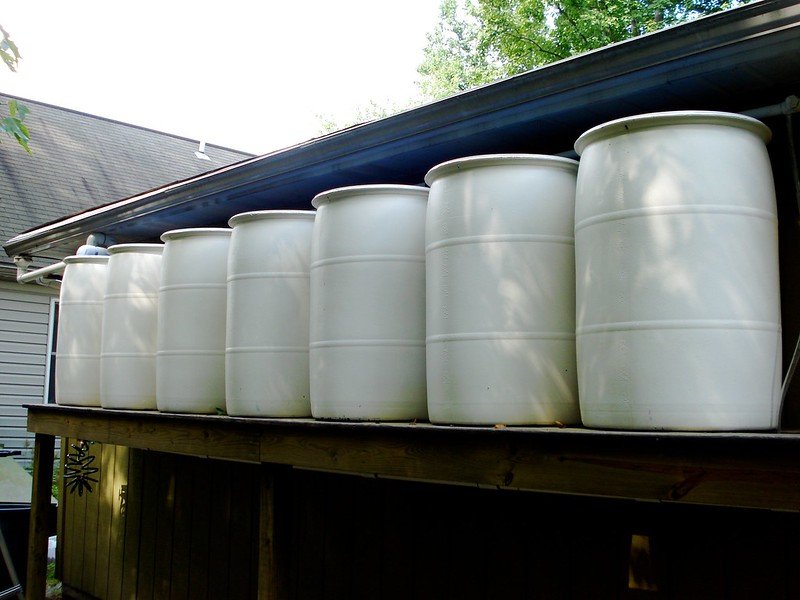
Add a cistern or rain barrel… or seven

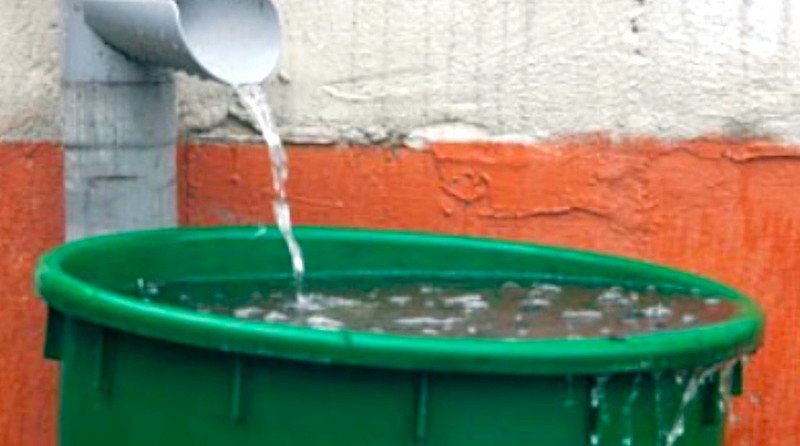
Our last suggestion is to add a cistern or rain barrel to capture rainfall which you can use later by pumping the water out for irrigation. Unlike infiltration which is designed to allow water to spread out underground during a rain storm, a cistern is supposed to hold water in the container, not diffuse it.

If you want to add an underground cistern–which is essentially a well filled with rainwater–you should consult with a landscape architect or soils engineer because there are certain critical engineering issues involved. The sides and bottom must be sealed to prevent water from escaping and the system must have an overflow drain. If water overflows in the wrong direction you may have serious and potentially expensive erosion problems.

On the other hand buying a big plastic barrel or one of the large above ground cisterns–prices start at about $100 and go up depending upon the size–can be a quick and easy method to store the rainfall from the downspouts on your roof until you use it later.

Are cisterns illegal?

In Colorado and Utah having a cistern on one’s own property to collect water used to be illegal. But no longer. Now Coloradans can have 2 rain barrels with a total capacity of 110 gallons of water for use on their own property. In Utah homeowners can save up to 2500 gallons in above or below ground cisterns to store water for use on the same property. In both these states, please check for specific local regulations.

Many other states, including Nevada and California, have regulations or are planning to enact them, about water harvesting and usage. California, for example, is encouraging water harvesting. To see if your state has regulations, go here.


Vote during lunchtime today

Read our 8 most popular newsletters

  1. Cover up that naked wall
  2. Australian Plants for a Desert Garden
  3. Potmen for a fun DIY addition to your garden
  4. Best and beautiful native shrubs for extreme heat
  5. Five fragrant plants for your garden
  6. Four desert trees good for soil, 4 toxic ones
  7. Plants that bloom even in mid-summer scorching heat
  8. Where to get free or cheap trees for your Western garden


Ask Me Anything and tree planting deception

Sorry, but “Ask Me Anything” has been canceled because there have been too many trolls.

In my Hot Gardens newsletter in the winter of 2006 I suggested that my online gardening friends do just 2 things for the new year: 1) plant a tree and 2) change one lightbulb to LED.

Rio Grande Fax Tex Ash autumn
The large Fan Tex Ash tree thrives i hot dry climates and has gorgeous golden leaves in Fall.

Asking people to change light bulbs seems terribly out of date now–everyone has already done it.
But planting a tree in your own garden is as smart and timely now as it was then. Especially since many ads about tree planting around the world and the U.S. are, as I have recently learned, somewhat misleading.

Deceptive ads about tree planting

We’ve all seen the ads telling us that Nepal or Ethiopia or some other country or a mega-international company has planted millions of trees.

And those claims of tree-planting are true and so inspirational!

But the ads tell only part of the story. As it turns out, some uncounted number of these millions of trees are being planted in ‘tree plantations’ and will be harvested in 10 to 20 years.

In a tree plantation there is no attempt to restore a natural forest which is more complicated than just sticking little trees in the ground lined up in neat rows. Trees in a plantation create a monoculture, rather than a diversified ecosystem. Each tree is like the next one all spaced for optimum growth with no smaller trees or shrubs in between. That means in 10 to 20 years when these more mature trees are cut down and hauled away the benefits of the trees will revert back to zero. Tree plantations are a short-term fix to a long term problem of rapidly increasing carbon dioxide in the air and climate change.

Crape myrtle Lagerstroemia indica hot pink
When most other plants are wearing summer green, the Crape myrtle bursts into colorful bloom. In dry climates it is a relatively small tree.

So I urge you to plant a tree or a few trees or long-lived shrubs in your garden in 2026. Become part of a long-term solution.


Our 8 Most Popular Newsletters

  1. Six landscape designs for replacing your front lawn
  2. Five fragrant plants for your garden
  3. Four trees good for soil; four toxic ones
  4. Cover up that naked wall
  5. Six flowering plants that reliably bloom in scorching mid-summer heat
  6. Take the screwdriver test for your lawn
  7. How to combat death by heat exhaustion of plants in pots
  8. Little Free Plant Stands and gardening tips