From Down Under to the High Desert: Australian Plants for Your Hot Garden

While winter still grips the northern latitudes, the “Land Down Under” is basking in the peak of summer heat. It’s the perfect time to look to Australia—the native home of the acacia, eucalyptus, and kangaroo paw—for inspiration. These plants are the ultimate survivors for hot, dry desert climates, offering a “plant and ignore” lifestyle that every busy gardener loves.

If you’re planning your springtime planting, consider adding these low-maintenance, drought-tolerant beauties to your landscape.

1. Acacias: The Soil-Building Beauty

The Acacia family is a desert gardener’s dream: they love the sun, require very little water, and—as a hidden bonus—actually fix nitrogen in the soil, improving its quality for neighboring plants.
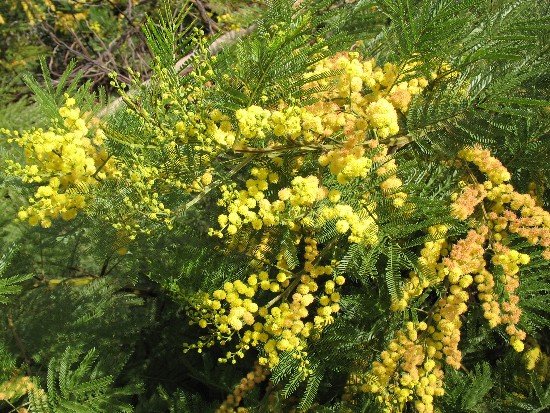
acacia in bloom

Golden Wattle (Acacia pycnantha): Australia’s national flower and the inspiration for the country’s green and gold colors.

Other acacias that thrive in our Southwestern gardens:

  • Cootamundra Wattle (Acacia baileyana): A fast-growing multi-trunk tree that brings a burst of fragrant, bright yellow blooms in mid-winter—a cheerful “genetic memory” of the Australian summer.
  • Prostrate Acacia (Acacia redolens): Need to cover a slope? This shrubby groundcover spreads up to 12 feet wide, thrives in poor soil, and features puffy, ball-like yellow flowers.

2. Eucalyptus: The “Dr. Seuss” Shade Tree

If you want shade and you want it now, Eucalyptus trees are your best bet. Famous for their whimsical, Dr. Seuss-like shapes, these rapid growers need almost no fertilizer—though an occasional dose of chelated iron can keep them looking vibrant.

  • Cider Gum (Eucalyptus gunnii): A hardy giant that can soar to 70 feet, showing off silvery-blue leaves and beautiful tan-and-green peeling bark.

    Other Eucalyptus that thrive in our climate:
  • Coral Gum (Eucalyptus torquata): Reaching 35 feet, this variety features light green leaves and exotic flowers that look like tiny Oriental lanterns.
  • Silver Dollar Tree (Eucalyptus cinerea): A floral arrangement favorite. Keep it trimmed back to maintain the iconic round, silver leaves; otherwise, they eventually turn long and green as the tree matures.

3. Natural Companions & Color Accents
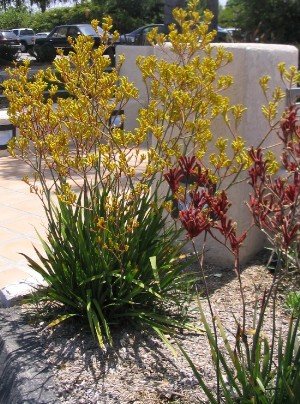
kangaroo paw

Looking for the perfect partner for your Eucalyptus? Try the Kangaroo Paw (Anigozanthos). These perennials look like unassuming tufts of grass until they shoot up 2-foot spikes topped with fuzzy, tubular flowers.

  • The “Bush Gem” Series: Hybrids like  ‘Bush Gold’ and ‘Bush Ranger’ are the sturdiest options, resistant to pests and a magnet for hummingbirds.



4. Echoes of the East Coast

If you miss the white birches of the Eastern U.S., the Australian Paperbark Tree (Melaleuca quinquenervia) is a stunning desert substitute. It features weeping branches and thick, light brown bark that peels away in papery layers.

  • Pro Tip: Use the peeled bark to line your wire hanging flower baskets—it’s both functional and beautiful!

5. The Bottle Brush Debate

Not all “indestructible” plants are created equal. While the Red Bottle Brush (Callistemon citrinus) is a common sight along California freeways, we prefer its more sophisticated cousin: Perth Pink.
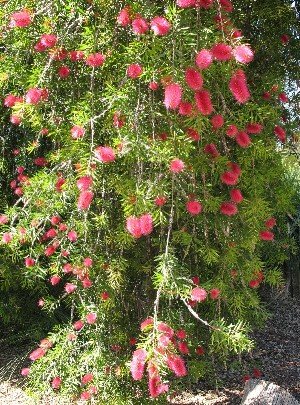
Callistemon Perth Pink bottlebrush
  • Perth Pink Bottlebrush: While the standard red can look a bit “utility,” the Perth Pink variety offers hot pink blooms that are absolute showstoppers. It thrives in xeriscape gardens and, while sometimes harder to find, is well worth the search.


Visit my author’s site to see books I’ve published.
All are now on Kindle Unlimited.


Hot Days, White Nights: How to Design a Moon Garden

When the desert mercury climbs, our relationship with our gardens shifts. We retreat indoors during the sizzling daylight hours, only to emerge when the air finally begins to cool after dusk. This shift is the perfect reason to design a Night Garden—a landscape specifically engineered to shimmer in moonlight.

A Quick Reality Check: While we’re dreaming of moonlit blossoms, remember the Hot Gardens golden rule: Plant in the Fall or early Spring. Once the temperature rises, new plants struggle to survive.

Here is your guide to the best white-blossomed, silver-leaved, and scent-heavy plants for a desert sanctuary. And as a bonus, learn which wildlife visitors your garden may have at night.


The Luminous Anchors: Trees & Shrubs

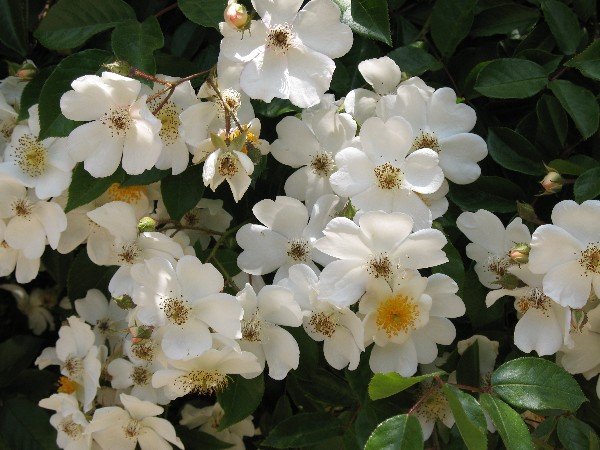
  • White Roses: Opt for white or pale yellow varieties. They offer a shimmering beauty and a classic fragrance that hangs perfectly in the balmy night air.
white rose
  • White Oleander (Nerium oleander): A rugged, water-wise alternative to roses. Beyond its months-long bloom cycle, it is fire-retardant—a vital feature if you live in high-risk wildfire zones. (Pro-tip: Always maintain a 100-foot defensible perimeter of cleared brush around your home)
  • Texas Olive (Cordia boissieri): Not a true olive, but a tough native shrub that starts its show in late Spring and often provides a “bonus” bloom in Autumn.
White Crape Myrtle

White Yarrow (Achillea millefolium): A sturdy native that requires almost no water once established—perfect for the “lazy” summer gardener.

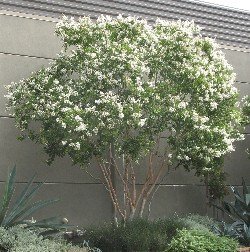
White Crape Myrtle (Lagerstroemia indica), left: In our alkaline desert soils, these are slow growers (topping out at 15–20 feet). Help them thrive by adding plenty of organic mulch to provide the acidity they crave.


Night-Scented Sensations

  • Evening Primrose (Oenothera caespitosa): Don’t confuse this with the invasive pink variety. This native white version blooms specifically at night and smells incredible. It grows in a mounded shape.
  • Moonflower (Ipomoea alba): A nocturnal cousin to the Morning Glory. Its massive white flowers unfurl at sunset like nature’s own lightbulbs. (Be careful that you do not buy Jimson Weed also known as Datura. It has large flowers that look like morning glory, but is poisonous and not suitable for gardens.)
  • White Jasmine & Hall’s Honeysuckle: These climbers are fragrance powerhouses. Honeysuckle pulls double duty, attracting bees by day and perfuming your patio by night.
  • Nicotiana alata: The wild species is the most fragrant, but the ‘Domino’ variety is much better at standing up to our intense desert heat.

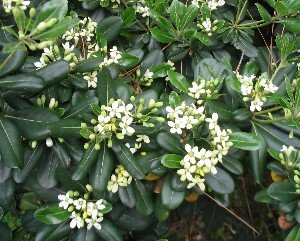
Pittosporum tobira: A sweet-smelling flowering shrub also called by the name mock orange. As a tree form it reaches 15 to 20 feet in height. It also comes with variegated leaves to add to nighttime luster.


Texture & Reflection: Silver Foliage

  • Lamb’s Ears (Stachys byzantina): The soft, fuzzy, silver-grey leaves act like a mirror for moonlight, creating a velvet-like carpet on the garden floor.
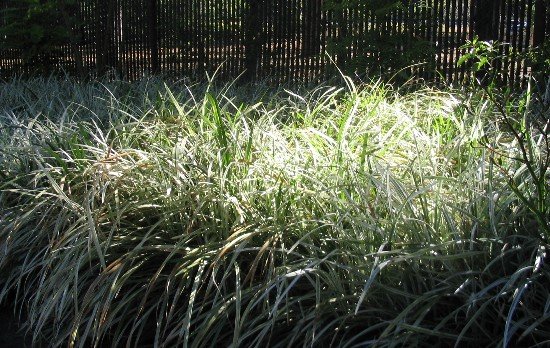
  • Variegated Turf Lily (Liriope muscari ‘Silvery Sunproof’): A durable groundcover with striped leaves that catch the light, finished with delicate summer blooms.
Variegated lirope turf lily

The Secret Sauce: White & Pale Yellow

When wandering your local nursery, keep one rule in mind: If it’s white or pale yellow, it belongs. These shades reflect the shortest wavelengths of light, meaning they will “glow” long after the sun sets, while reds and purples disappear into the shadows.


The “Night Shift” Pollinators

While you’re enjoying the cooler air, your garden is hard at work. By planting white, fragrant, and night-blooming species, you are creating a vital pit stop for the desert’s nocturnal ecosystem.

  • Sphinx Moths: Often mistaken for hummingbirds due to their size and hovering ability, these moths are the primary fans of Moonflowers and Evening Primrose. Their long proboscises are perfectly evolved to reach deep into tubular white blooms.
  • Nectar-Eating Bats: In the Southwest, lesser long-nosed bats and Mexican long-tongued bats are crucial pollinators. They are drawn to the pale, sturdy flowers of the Texas Olive and native cacti.
  • Nocturnal Bees & Beetles: Many smaller desert residents rely on the highly visible “landing pads” of White Yarrow and Dwarf Cup Flower to find food in the dark.


Visit my author’s site to see books I’ve published.
All are now on Kindle Unlimited.

How to Save a “Patio-of-Shame”

While it is 3 degrees fahrenheit in Chicago today, patio season is already here in Southern Arizona and coming soon to the rest of the Southwest. The days are warmer now, but before you invite a friend over for lunch in the sunshine or plan an early family dinner outdoors, take a long look at your patio. Is it a “patio-of-shame”–an utterly plain, bare concrete slab behind your home that you never got around to changing? Or did you update it a few years ago, but now that update looks tired and worn?

Well, whatever the condition of your current patio, here are a few ideas for lifting it out of the category of “patio-of-shame”. Prices online for these updates range from below $20 to amazingly, impossibly extravagant.

Start by Creating Shade

An unshaded patio is a Never-Used patio. But if your garden patio area is already a source of pride and covered with a roof or arbor you are now ahead of the game. No shame here. Not only will these architectural features shade your patio, they will keep direct sun off the side of your home and reduce air conditioning bills.  Custom-built arbors or pergolas can be very expensive; you could end up spending thousands of dollars for one. There are, however, arbor kits available at garden centers, home improvement stores, and online that cost considerably less. Even then, prices start in the $300 range and go way up into the thousands of dollars.

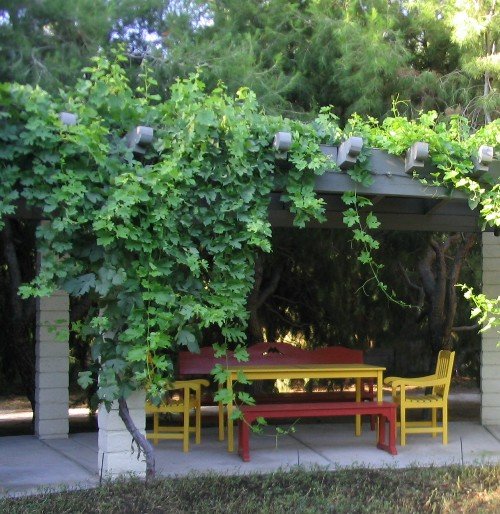
grape vine on arbor

One of the lovely features of a sturdy arbor is that it allows you to plant cooling, climbing vines, such as Grapes (Vitis vinifera), shown in this photo, or fast-growing Trumpet Vine. Both are lush green in summer and lose their leaves in winter to allow in warming sun when you need it.

Another popular shade-creating solution, and much less expensive than an arbor or pergola, is an awning that attaches to the side of your home. It can be rolled up during winter and rolled out in summer giving protective shade even when the temperature goes into triple digits. If you go this route be sure to ask how the fabric holds up to blazing sunlight and monsoon downpours.

Stepping down to an even less expensive way to add shade is to install a sun sail. Prices for these large pieces of material — usually canvas but also available in bamboo–start at around $100 plus the cost of installing poles and fixtures to attach the sun sail. The color selection for these sails seems endless so be daring, but ask if the fabric is fade-resistent.

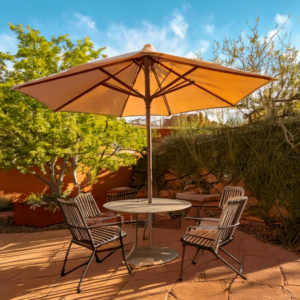
Still another option, if you are doing this update on a budget, is to purchase a market umbrella for your patio table. Choose one that fits into a hole in the center of your table or an umbrella that cantilevers out over your table from a base set off to the side. Cantilever-style umbrellas can be dual-purpose because they are easily moved to cast shade on a chair or other outdoor furniture after you’ve finished eating. Interestingly enough, cantilever umbrellas are not as expensive as I thought; you can buy one for around $100. ProTip: string tiny, white Christmas lights inside the umbrella to give it a festive feel on mid-summer nights.

And this brings us to…

Patio furniture for every taste and budget

Rather than discuss patio furniture in detail, I’ll just say that there are more styles and colors and prices for outdoor furniture than you can shake a stick at! I even saw one of those cheap, super-practical plastic chairs, brand-new, for under $20 online.

If you do not want to buy new, you can find some good quality, second-hand outdoor furniture on the online want ads. Craig’s List, Next Door, and Facebook all have local marketplace listings. Avoid using second-hand pillows and furniture pads, however. You don’t know who or what has lounged around on them, soiling them, even if they look clean.


If you buy used patio furniture, paint it to make it new-for-you. There are a gazillion colors of outdoor furniture paint and even special paints for those ubiquitous plastic chairs. Because you can always change a color later if you change your mind or if the paint fades, take a risk with outdoor furniture paint and try a color or shade you would never use inside your home. Make it fun!

Okay, so now here you are, sitting in the shade on attractive outdoor furniture–maybe even with a big round dinner table in front of you. Maybe you want to celebrate your new patio update and someone says…

“Pizza anyone?”

While humans have been eating food cooked on a fire for hundreds of thousands of years, cooking in a outdoor kitchen is fairly new — and an installed full kitchen with refrigerator, oven, and grill, on a patio is an extravagance, no question about that. It could easily cost $5,000, $7,000 or more. Installing the wiring and plumbing are the largest costs.

But at the other end of the scale of outdoor cooking equipment is the simple-to-use iron hibachi. It’s small and cooks just fine using charcoal. I used one for years to grill burgers for my children on a balcony in Los Angeles. Prices range from about $50 and up.

My favorite invention, however, is the outdoor pizza grill. Unlike all those big, black or green “Dad-grills” powered by charcoal or gas, portable pizza grills are compact and some are even wood-fired just like pizza ovens in Italian restaurants. A delicious pepperoni and mushroom pizza cooked right from the freezer along with a green salad makes a tasty, easy family dinner and a welcome change from burgers or chicken. Pizza grills start at around $170 and some have multiple levels so they can be used for grilling chicken at the same time the pizza is cooking.

Now, if only some robot would clear the patio table after dinner and do the dishes as well. Which brings us to Part 2 of The Patio Series in my next Hot Gardens newsletter. It’s entitled The Gadgety Garden. See you there!


Read our 8 most popular newsletters

  1. Cover up that naked wall
  2. Australian Plants for a Desert Garden
  3. Potmen for a fun DIY addition to your garden
  4. Best and beautiful native shrubs for extreme heat
  5. Five fragrant plants for your garden
  6. Four desert trees good for soil, 4 toxic ones
  7. Plants that bloom even in mid-summer scorching heat
  8. Where to get free or cheap trees for your Western garden

Turn a love of gardening into extra cash

Mother Nature can be your BFF if you want to turn your love of gardening into a source of extra spending money. And it is so simple. All you need are inexpensive pots you can buy on Amazon or your local garden center, some potting soil and patience. Then, on a sunny Saturday, hold your “garden sale” on your driveway.

Here is how to start creating cash from plants

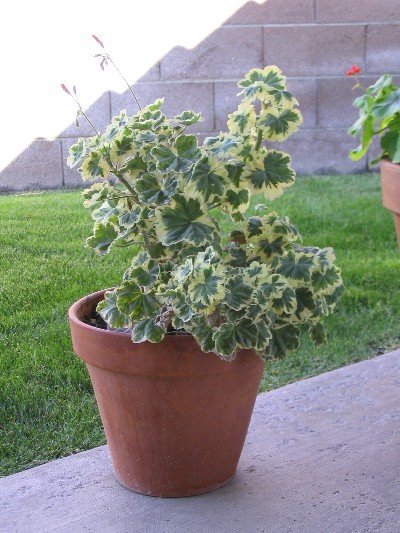
varigated pelagornium geranium

Take cuttings from special plants in your garden and plant them in small plastic pots–like the ones you see in the local garden center. Actually, the plants don’t have to be rarities, but they do have to be healthy. For example, if you have a sturdy geranium (Pelargonium) with pretty blooms or varigated or scented leaves, take a few 4″ to 6″ long cuttings for starters. Then stick the cuttings in a inexpensive plastic pot filled with good potting soil. And water frequently. If you think that your geranium seems too ordinary, keep in mind that you liked it enough to buy it, so, no doubt, other people will like it too. You could even have an example in bloom nearby during your garden sale so people can see how attractive it is. It may take six weeks for the geranium cutting to take root.

Divide to multiply

Another example of a plant to sell would be iris, which grow well in hot dry climates as well as looking beautiful. You should divide iris rhizomes every 2 to 5 years anyway, so why not keep some and offer others for sale? Be sure to cut the leaves back to 5 to 6 inches and clearly label the color and if the iris is a rebloomer.

Depending upon where you live, you may also have agapanthus in your garden and they are good candidates for dividing. Simply dig up the root ball, cut it into 2 or 3 large size pieces, replant one section in your garden and sell the others. You should probably divide the iris and the agapanthus just before your driveway garden sale. They should not dry out before replanting. It might also be helpful to your customers to have a little note to give them about planting iris and agapanthus. Each has different requirements.

Then there are seedlings–pick your favorite annual flowers and herbs–which should be started in very small pots again like at the garden center. Then water and wait.

Mother Nature should do her work within a few weeks. The cuttings will have taken root and the seeds should have sprouted to produce seedlings.

Advertise your private garden sale

Then hold a “garden sale” on your driveway on a Saturday morning. Post signs around your neighborhood. List your garden sale online on Craigs List or Next Door. Post notices about it on community bulletin boards. 

Before the sale begins do some research about pricing. As you probably know, iris rhizomes are expensive and agapanthus, too, so price yours accordingly. But geraniums are priced lower and herb seedlings even lower at garden centers and yours should be, too. And at the end of the garden sale day, you pocket the money you made and move any unsold pots into your back yard to continue growing until you hold your next garden sale.


Selling unusual plants for microclimates

Hot gardens plumeria blossoms
Plumeria blossoms are exceptionally fragrant and the plant–a small tree–can grow indoors.

Not long ago we spoke with a man at a California farmer’s market who had trimmed an old tropical Plumeria tree in his back garden and put the 2 foot long ends of the trimmed branches into big plastic pots filled with rich potting soil.  Several months later, when he was confident the cuttings had taken root, he held a garden sale on his driveway based on one ad on Craigs List. And he earned over two thousand dollars over two weekends.

A few weeks later he showed up at a farmers’ market with the few remaining potted Plumeria and proceeded to sell them in another couple of weekends. His goal for his garden sale was to raise money for his daughter’s college education.

One of the reasons he was so successful was that Plumeria trees had just begun making a comeback in popularity after 50 years of being pretty much ignored.  His Plumeria was also of a rare color, which made it all the more desirable and allowed him to charge higher prices.

It’s important to note that Plumerias need a sheltered microclimate in a Southwest desert garden; their leaves will burn when subject to intense, all day sunlight. (Sorry, Phoenix, no plumeria trees for you.) On the other hand, they do well in Mediterranean climates where the temperature doesn’t rise over 90-95F very often.


Cacti and condos – meant for each other

A retired couple we know sell succulents and cacti in small, colorful pots at a local open air market for extra retiree income. Cacti and succulents are often the plants of choice with apartment and condo owners because they grow very slowly and can be ignored for weeks without whithering and dying. Of course, cacti and succulents are the mainstay of many desert gardens so homeowners are also potential buyers.

And as with the other garden sale ideas in this post, Mother Nature does most of the work in producing the products you sell. And you harvest the profits.


Visit my author’s site to see the books I’ve published.


Read our 8 most popular newsletters

  1. Cover up that naked wall
  2. Australian Plants for a Desert Garden
  3. Potmen for a fun DIY addition to your garden
  4. Best and beautiful native shrubs for extreme heat
  5. Five fragrant plants for your garden
  6. Four desert trees good for soil, 4 toxic ones
  7. Plants that bloom even in mid-summer scorching heat
  8. Where to get free or cheap trees for your Western garden

Composting is an unnatural act…

Well, composting is unnatural in a hot dry climate where plants produce small leaves with waxy or oily exteriors, where grassy lawns are few and far between and where the air is, more often than not, dry as a bone.

Those are things that are antithetical to the natural composting that occurs in cooler, more forested zones where big leaves and/or lots of pine needles, weekly grass clippings from the lawn, and damp air make composting a normal part of the environment and is fairly easy for a gardener to do.

So because it is not a natural function in a hot dry climate, I’ve never written about it.

During this last month, however, I received an question about it so if you want to start composting, even though you are living in a hot dry climate, here is some advice.

First: the good news about compost. Compost is food for the soil. It loosens the soil hardened by heat and dry air and makes it easier for plant roots to grow deep. It enriches the earth with long-lasting nutrients. Used as a mulch on flower beds it can be protective.

But compost should not be used in place of fertilizer. Its carbon to nitrogen ratio is too unstable, too unpredictable to count on as a fertilizer. In fact, if the compost process isn’t fully complete, the compost may suck nitrogen right out of your soil. Compost that is “complete” is crumbly, not smelly, dark brown or almost black and will, very gradually over years, release some nutrients to your plants and help balance the pH in your garden.

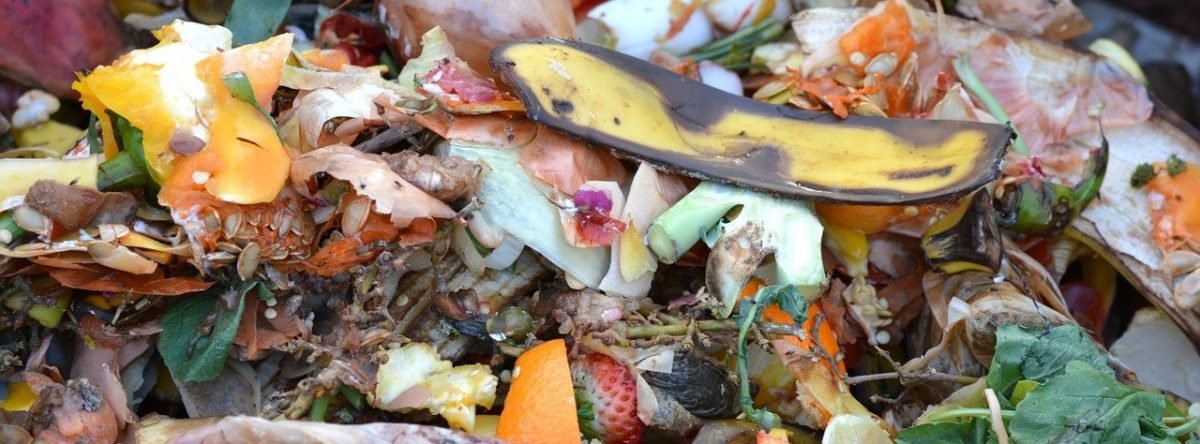
composting food waste

Now to get started the first thing you are going to need is a place or a container to hold the garden and kitchen waste you want to turn into compost.

From left: beginning, middle and done with composting!

When I had a compost heap in my Santa Barbara garden, it was just that, a heap of grass clippings and leaves in the far corner of my backyard that had been started by the previous owner. If I was doing it again, I would have either set up attractive wooden bins or put everything into metal canisters that could be turned. (Live and learn!)

Then begin by adding biodegradable stuff, such as grass clippings, leaves, coffee grounds, sawdust, faded flowers, dead annuals, and even newspapers torn up into little bits. You need a mix of one part green stuff to 3 parts brown stuff for the best composting process. For green stuff you add things like grass clippings; brown stuff are things like chopped straw or old dead dry leaves.

Next, toss in a shovel or two of your native soil to jump-start the process. NO need to buy compost bacteria or fungi starter. Your native soil has what you need.

And dampen the whole thing. Don’t soak it. Just keep it damp like a sponge that has been wrung out. This is especially important in our dry climates. You may have to dampen it daily…or more often. If possible, keep your compost in the shade so it won’t dry out as quickly.

Be sure to turn it regularly so the decomposing process continues on all materials, not just those on outside. When you turn it you may discover it is warm or hot in the center. The center of the compost bin may heat up to 130F, which should kill all the wild seeds that ended in it. If it becomes too hot, that is a sign of excess carbon and you should add more green stuff, like grass clippings or weeds you pulled from your garden.

raccoon by wall

Now about food waste. If you are composting in a container, especially a revolving one up off the ground, toss in all the food waste you have. BUT, if your compost “bin” is actually a compost heap you may find wild raccoons and other hungry animals visiting it. They love those old apple cores, orange peels, rotting pumpkins, bananas and other food leftovers.

Do NOT put meat or dairy in your compost pile. It will not decompose quickly, will smell hideous and may attract vermin or dangerous bacteria to your garden. Also avoid leaves of oleander, they are poisonous. And avoid adding eucalyptus and salt cedar leaves.

I strongly recommend acquiring some type of plastic or metal compost bin. Some cities offer residents free compost bins, so call your local government to see if you can get one or two for free. There are also several on Amazon that look good, including a pink compost bin. One even claims to be able to make compost in two weeks! That’s fast! Composting usually takes months. Happy composting!


Where to get a free or cheap tree for your home.


Read our 8 most popular newsletters

  1. Cover up that naked wall
  2. Australian Plants for a Desert Garden
  3. Potmen for a fun DIY addition to your garden
  4. Best and beautiful native shrubs for extreme heat
  5. Five fragrant plants for your garden
  6. Four desert trees good for soil, 4 toxic ones
  7. Plants that bloom even in mid-summer scorching heat
  8. Where to get free or cheap trees for your Western garden


Succulents bring winter color and possible danger

Green and black Aeoniums and orange Firestick Euphorbias seem to be closing in on the Agave for the title of the most popular drought tolerant plants used in desert landscapes or for lawn replacement. They are showing up everywhere, it seems, from small front garden plots to street side plantings to pots on patios.  So this post was originally going to be about some attractive plantings of these succulents that I have seen recently.

But as I did more research, I learned that, as beautiful as they are, some can pose a real danger to pets…and potentially to people. Some are quite toxic.

Firestick succulents (Euphorbia tiruccailli ) are used as a hedge outside a restaurant in Pasadena California.  You can trim them to keep the plant smaller, but be sure to wear gloves and even goggles: the white sap is toxic.  Place cuttings into a plastic bag that you can tie up tight so pets will not be exposed to the sap.

In Pasadena’s Arlington Garden Firestick euphorbias have been left untrimmed for over a decade and are now approaching 25 feet in height. The cactus in the center has also become a tall, beautiful focal plant.  

The mix of plants in this curbside border–aeoniums, daisies and a firestick succulent–looks great now, but the firestick will grow up to 30 feet tall if left untrimmed. As with all flower/plant borders, it is important to think ahead as to how large each plant will become at maturity. Or be willing to prune some big plants and replace others to maintain the appearance. In this group, the daisy plant will die long before the succulents do.

A mix of succulents in a curbside planting demonstrates the variety of color these tough plants can provide. Lurking in the middle, however, is a potential giant: the Firestick euphorbia!  But its orange color is a nice complement to the blue-ish Secenio Talindoides, the green Aeonium, and the brown-ish Kalanchoe.

I love how the color of the bell-like Kalanchoe blooms coordinate with the glass ball on the top of this ornamental garden statue! You may be more familiar with one variety of the Kalanchoe known as the “flapjack” plant. It has large pink 
and green leaves.The blossoms appear to be sprouting up from the bright green Aeoniums, but actually are from the pink-ish Kalanchoes on the left.  


Visit my author’s site to see books I’ve published.
All are now on Kindle Unlimited.

Read our 8 most popular newsletters

  1. Cover up that naked wall
  2. Australian Plants for a Desert Garden
  3. Potmen for a fun DIY addition to your garden
  4. Best and beautiful native shrubs for extreme heat
  5. Five fragrant plants for your garden
  6. Four desert trees good for soil, 4 toxic ones
  7. Plants that bloom even in mid-summer scorching heat
  8. Where to get free or cheap trees for your Western garden